Maximum Recoverable Volume (MRV): How Much Training Volume Is Too Much?
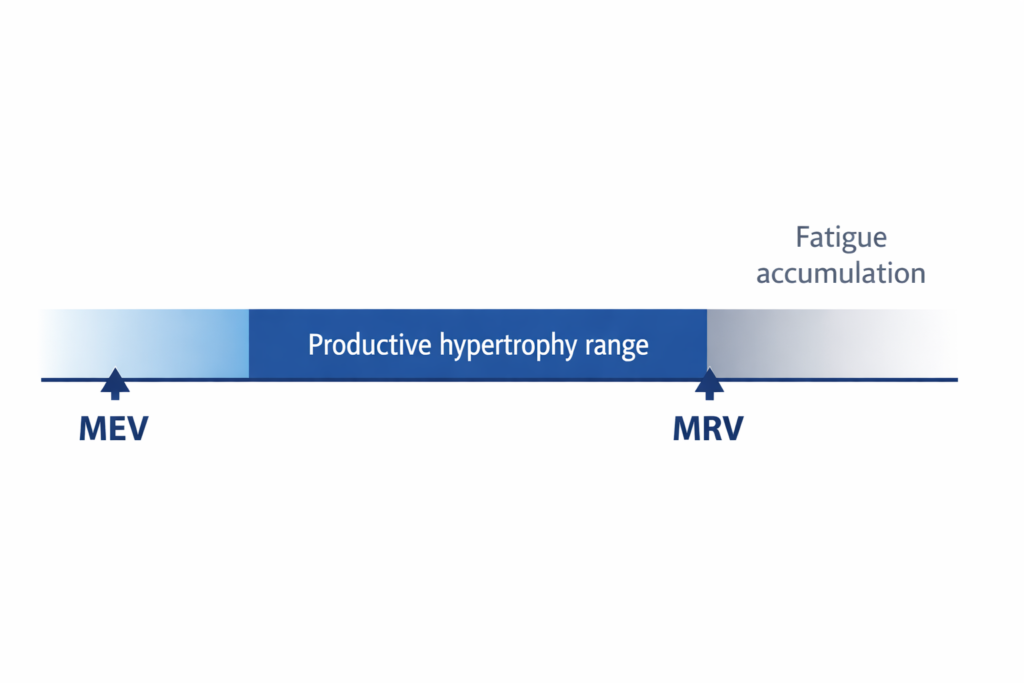
Maximum recoverable volume (MRV) refers to the highest amount of training volume your body can recover from while still making progress. When training volume exceeds this threshold, fatigue begins to accumulate faster than recovery, which can stall performance and limit hypertrophy.
Understanding MRV helps lifters structure training volume more effectively and avoid the common mistake of assuming that more sets always lead to more muscle growth, which is why learning how to determine your optimal training volume is essential.
This concept is best applied within a structured system of hypertrophy program design.
TL;DR
- Maximum Recoverable Volume (MRV) is the highest training volume you can recover from while still making progress.
- Training above MRV typically leads to fatigue accumulation, stalled performance, and reduced hypertrophy.
- MRV varies between individuals depending on sleep, nutrition, stress, and training experience.
- Signs of exceeding MRV include declining performance, persistent soreness, and reduced motivation to train.
- Effective hypertrophy programming usually stays below MRV but above minimum effective volume (MEV).
Watch: How to Find Your Optimal Training Volume
Prefer to watch? This video walks you through five practical questions for finding your optimal training volume—including how to recognize when additional sets stop being productive and when maintaining or reducing volume is the better decision.
Conceptual Foundation
In hypertrophy training, volume is one of the main drivers of muscle growth. However, more volume is not always better.
At some point, additional sets stop producing extra stimulus and instead create excessive fatigue. This point is known as maximum recoverable volume (MRV).
MRV represents the upper limit of productive training stress. If weekly training volume exceeds this limit, the body cannot recover fully between sessions and performance may begin to decline.
In practical terms the hypertrophy volume spectrum ranges from minimum effective volume (MEV) to maximum recoverable volume (MRV):
Below MEV
Not enough stimulus to reliably drive muscle growth.
Between MEV and MRV
The productive hypertrophy range where training stimulus is high but recovery is still manageable.
Above MRV
Fatigue accumulates faster than the body can recover.
Because of this, MRV acts as a practical ceiling for effective training volume.
When training volume consistently exceeds your maximum recoverable volume (MRV), fatigue accumulates faster than the body can recover, which is often referred to as too much training volume.
At higher volumes, fatigue is not always limited to individual muscles, but can accumulate as a broader systemic fatigue state that affects overall performance.
Evidence Review
Research consistently shows that hypertrophy increases as training volume rises up to a certain point.
Meta-analyses by Schoenfeld and colleagues suggest that performing more weekly sets per muscle group generally leads to greater hypertrophy. However, the relationship does not appear unlimited. Beyond certain volumes the additional benefit tends to plateau while fatigue continues to increase.
This is where the concept of maximum recoverable volume becomes relevant.
When training volume becomes excessive, several negative effects may occur:
reduced performance in later workouts
impaired recovery between sessions
higher injury risk
stagnation in strength progression
Even if additional sets theoretically provide more stimulus, the systemic fatigue they generate can outweigh the benefits.
Recovery capacity also differs significantly between individuals. MRV is therefore not a fixed number but a moving threshold influenced by several factors:
training experience
sleep quality
calorie intake
stress levels
exercise selection
For example, a lifter dieting aggressively or sleeping poorly will usually tolerate less training volume compared with someone who is well rested and eating in a caloric surplus.
System-Level Implications
MRV is rarely something lifters should train at continuously.
Most effective hypertrophy programs gradually increase training volume across a training block. As fatigue accumulates, the program eventually approaches MRV before reducing volume during a deload phase.
A typical structure looks like this:
Start near MEV
Gradually increase weekly volume
Approach MRV toward the end of the training block
Deload to reduce accumulated fatigue
This progression allows lifters to accumulate productive training stimulus while preventing long-term fatigue buildup.
Hypertrophy training depends on balancing training volume and intensity so that stimulus remains high while fatigue stays manageable.
It is also important to remember that MRV changes over time. Factors such as life stress, sleep quality, and nutritional intake can temporarily raise or lower recovery capacity.
Practical Implementation
Because MRV varies between individuals, it is usually identified through performance trends and fatigue signals rather than through a specific number of sets.
Several indicators suggest that training volume may be approaching or exceeding MRV.
Performance decline
If loads or repetitions decrease across several sessions despite consistent effort, accumulated fatigue may be interfering with recovery.
In some cases, performance decline is not purely a muscular issue, but also reflects central fatigue mechanisms that reduce neural drive and overall output.
Persistent soreness
Muscle soreness (DOMS) lasting several days may indicate that recovery capacity is being exceeded.
Reduced training motivation
Psychological fatigue often appears when training stress becomes excessive.
Systemic fatigue
Poor sleep quality, reduced energy levels, or difficulty concentrating may accompany high levels of accumulated training stress.
A practical strategy is to gradually increase volume until progress slows or fatigue becomes noticeable. Reducing volume slightly at that point often restores recovery and performance.
When training volume exceeds MRV, fatigue accumulates faster than the body can recover.
How to Know If Your Training Volume Is Too High
One of the most practical ways to estimate maximum recoverable volume is by monitoring fatigue signals.
Several signs may indicate that your current training volume exceeds your recovery capacity.
Performance stops improving
If strength or repetitions stagnate for multiple sessions despite consistent effort, accumulated fatigue may be interfering with recovery.
Persistent muscle soreness
Muscle soreness lasting several days after training may suggest that recovery is incomplete.
Declining training motivation
When volume becomes excessive, psychological fatigue often appears alongside physical fatigue.
Reduced performance across sessions
If multiple exercises start regressing simultaneously, overall fatigue may be exceeding your recovery capacity.
In most cases, slightly reducing weekly training volume restores recovery and allows progress to resume.
Why it matters
Many lifters assume that simply adding more sets will accelerate muscle growth.
In practice, training beyond recovery capacity often slows progress rather than improving it.
Understanding maximum recoverable volume helps lifters avoid excessive fatigue, structure training blocks more effectively, and maintain consistent strength progression.
Together with minimum effective volume (MEV), MRV helps define the productive training zone where hypertrophy is most likely to occur.
References
Schoenfeld, B. J., Ogborn, D., & Krieger, J. W. (2017). Dose-response relationship between weekly resistance training volume and increases in muscle mass.
https://pubmed.ncbi.nlm.nih.gov/27433992/
Grgic, J., Schoenfeld, B. J., & Latella, C. (2018). Resistance training volume and muscle hypertrophy: A systematic review and meta-analysis.
https://pubmed.ncbi.nlm.nih.gov/30153194/
Pareja-Blanco, F., et al. (2017). Time course of recovery following resistance training leading or not to failure.
https://pubmed.ncbi.nlm.nih.gov/28486337/