Progressive Overload Explained: The Key to Long-Term Muscle Growth
TL;DR
- Progressive overload means gradually increasing the training stimulus over time
- It is essential for continued muscle growth and hypertrophy
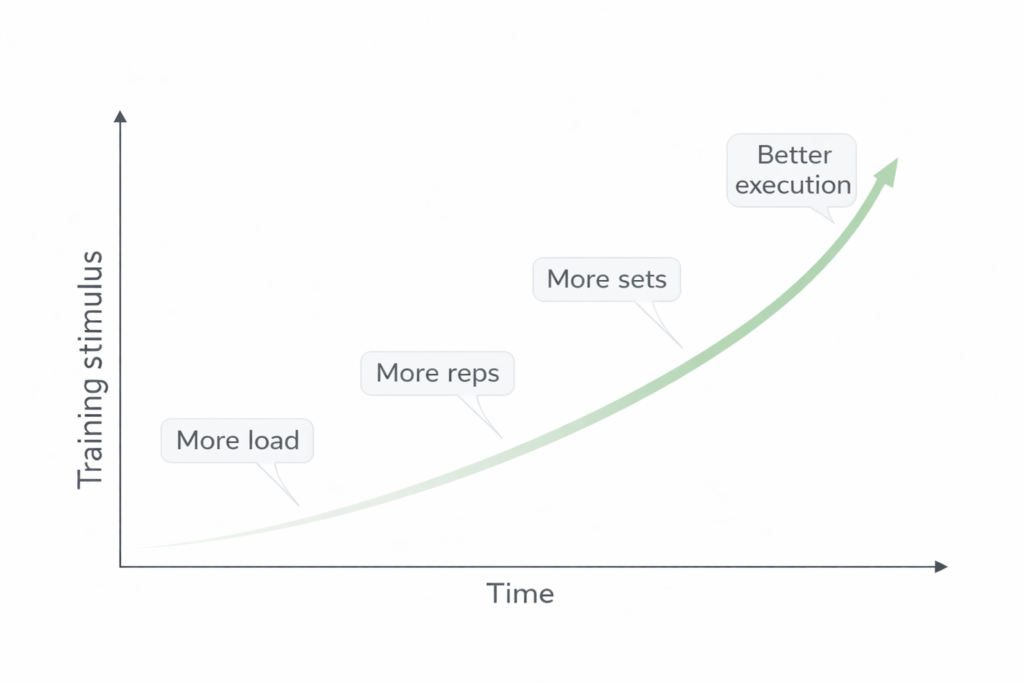
- Overload can come from more weight, reps, sets, or better execution
- You do not need to add weight every workout
- Without progressive overload, long-term muscle growth stalls
Beginner explanation: what is progressive overload?
Progressive overload is the foundational principle behind all long-term muscle growth.
Progressive overload does not operate in isolation. It must be applied within a structured training system where volume, frequency, and recovery are aligned. For a complete framework, see how to design a hypertrophy training program.
In simple terms, it means that your muscles must be challenged slightly more over time than they are currently used to. When you expose your muscles to a training stimulus they can already handle, there is little reason for them to adapt further.
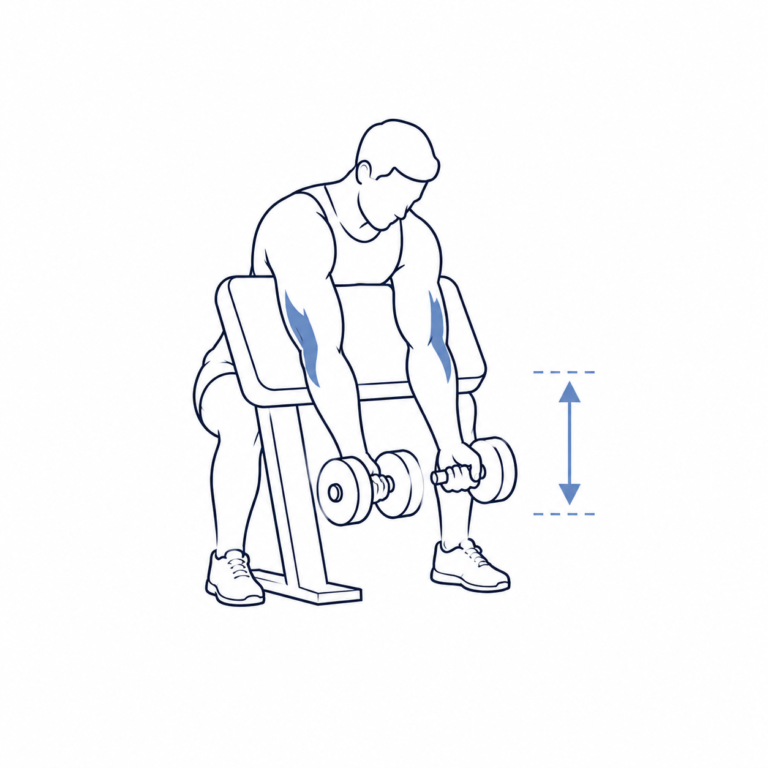
That “extra challenge” does not have to mean adding weight every session. Progressive overload can occur through multiple variables, such as:
- Performing more repetitions with the same weight
- Adding small amounts of load over time
- Increasing the number of sets
- Improving technique or range of motion
- Increasing training frequency for a muscle group
What matters is not how overload is achieved, but that the overall stimulus increases gradually and sustainably.
Why progressive overload drives muscle growth
Muscle growth (hypertrophy) occurs as a response to mechanical tension placed on muscle fibers. When the body detects that the current muscle size and strength are insufficient to handle repeated stress, it adapts by increasing muscle protein synthesis and structural capacity.
Progressive overload ensures that:
- The stimulus remains above your current adaptation level
- Muscles receive a consistent signal to grow
- Training remains effective beyond the beginner phase
Without overload, training becomes maintenance — not growth-oriented.
Common misconceptions about progressive overload
“You must add weight every workout”
This is one of the most common misunderstandings.
Strength and performance fluctuate due to sleep, stress, nutrition, and recovery. Expecting linear load increases session-to-session is unrealistic, especially for intermediate and advanced lifters.
Progressive overload works best when evaluated over weeks and months, not single workouts.
“More volume automatically means overload”
Adding sets endlessly is not sustainable. Volume increases are a tool — not a requirement.
Excessive volume without adequate recovery can reduce performance and blunt hypertrophy, even if total workload increases.
“Failure is required for overload”
Training to failure can increase stimulus, but it is not mandatory and often comes with higher fatigue costs.
Progressive overload can occur while leaving 1–3 reps in reserve, especially when volume and load are well controlled.
Practical methods of progressive overload
Below are the most effective and evidence-based ways to apply progressive overload in hypertrophy training.
1. Load progression
Gradually increasing the weight lifted while keeping reps and technique consistent.
Example:
8 reps at 80 kg → 8 reps at 82.5 kg
This method is effective but should be applied conservatively.
2. Repetition progression
Increasing reps within a fixed load range before adding weight.
Example:
8 → 9 → 10 reps at the same weight, then increase load
This approach is especially useful for hypertrophy-focused training.
3. Set progression
Increasing the number of hard sets over time.
Example:
2 sets per exercise → 3 sets per exercise
Set progression should be used sparingly to avoid unnecessary fatigue.
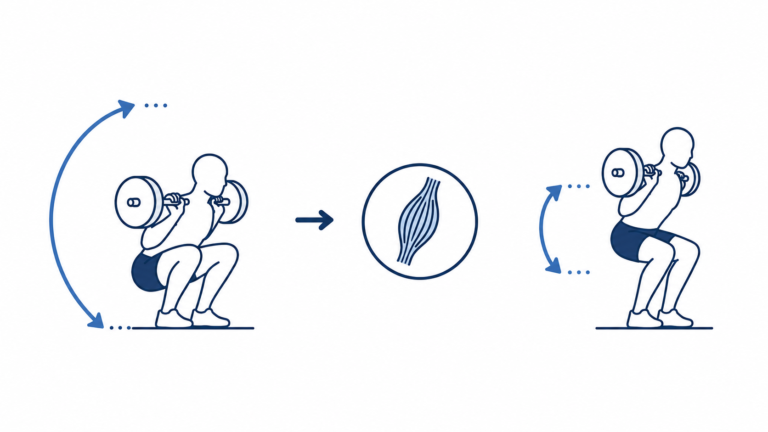
4. Execution and range of motion
Improving technique, control, and range of motion increases effective tension without changing load.
Slower eccentrics, deeper ranges, and more consistent execution all count as overload.
How fast should progressive overload happen?
Slower than most people expect.
For most lifters:
- Beginners may progress weekly
- Intermediates progress over several weeks
- Advanced lifters progress over months
Trying to force rapid overload often leads to stalled progress, joint issues, or burnout.
Consistency beats aggression.
Progressive overload is only effective if your body has the resources to adapt. Use our free Macro Calculator to estimate your daily calorie, protein, carbohydrate, and fat targets so your nutrition supports long-term progress.
Progressive overload vs periodization
Progressive overload is the principle.
Periodization is the structure used to apply it.
Volume cycles, deloads, and intensity phases exist to manage fatigue so overload can continue long-term. Without planned recovery, overload eventually stops working.
References
Schoenfeld, B. J. (2010). The mechanisms of muscle hypertrophy and their application to resistance training. Journal of Strength and Conditioning Research.
https://pubmed.ncbi.nlm.nih.gov/20847704/
Krieger, J. W. (2010). Single vs. multiple sets of resistance exercise for muscle hypertrophy. Journal of Strength and Conditioning Research.
https://pubmed.ncbi.nlm.nih.gov/20300012/
Helms, E. R., et al. (2018). Evidence-based recommendations for natural bodybuilding contest preparation. Journal of the International Society of Sports Nutrition.
https://pubmed.ncbi.nlm.nih.gov/29606933/