Pre Workout Supplements: What Actually Works?
Pre workout supplements are popular because they promise a simple outcome: more energy, better focus, stronger sets, and better workouts.
Some ingredients can genuinely help performance. Others are mostly there to make the label look more impressive.
The problem is that “pre-workout” is not one supplement. It is a category. A good pre-workout depends on the ingredients, the doses, your tolerance, your training time, and whether the product solves an actual problem in your routine.
This article explains what actually works, what is overhyped, and how to choose a pre-workout without relying on marketing claims.
In practical terms, pre workout supplements are only worth using if they improve training quality without creating problems for sleep, recovery, or consistency.
TL;DR
- Pre-workout supplements can help training performance, but most benefits come from a few specific ingredients.
- Caffeine is usually the most reliable acute performance ingredient.
- Citrulline may help with pumps and some resistance-training performance outcomes, but it is not magic.
- Beta-alanine can support repeated high-intensity efforts, but it works through consistent supplementation, not immediate pre-workout timing.
- Creatine is one of the best-supported supplements for strength and muscle gain, but it does not need to be taken before training.
- Many pre-workouts are underdosed, overloaded with unnecessary ingredients, or hidden behind proprietary blends.
What Are Pre-Workout Supplements?
A pre-workout supplement is usually a powder or drink taken before training to improve energy, focus, pumps, or performance.
Most formulas combine several ingredients, often including caffeine, amino acids, nitric oxide boosters, electrolytes, sweeteners, flavoring agents, and sometimes creatine or beta-alanine.
The important point is this: pre-workout is only useful if the ingredients are effective and dosed properly.
A product can feel strong because it contains a lot of stimulants, but that does not automatically mean it improves hypertrophy. For muscle growth, the real question is whether it helps you train better: more productive sets, better effort, better focus, or more consistent performance over time.
Pre-workout should support the training process. It should not replace sleep, food, hydration, programming, or progressive overload.
The Ingredients That Actually Matter
Most pre-workout labels contain many ingredients, but only a smaller group deserves serious attention.
Caffeine
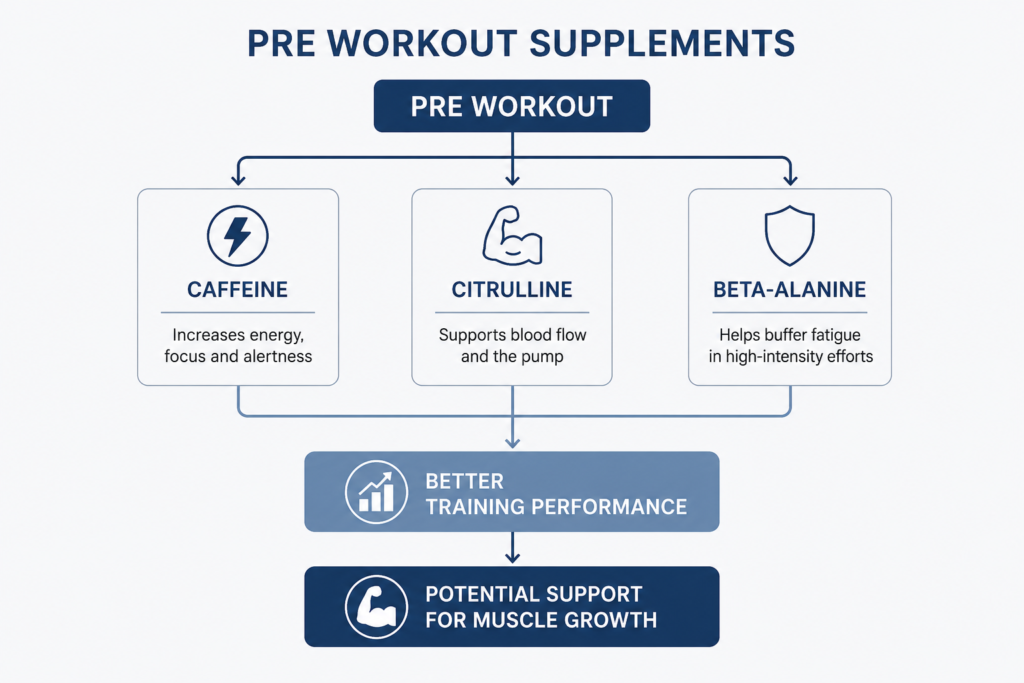
Caffeine is usually the main reason a pre-workout feels like it “works.” It can increase alertness, reduce perceived effort, and improve performance in some training contexts.
For resistance training, caffeine may help strength, power, and muscular endurance, although individual response varies. Some lifters feel a clear improvement in focus and effort. Others mainly feel anxious, overstimulated, or notice worse sleep if they take it too late.
Common evidence-based doses are often discussed around 3–6 mg/kg body weight, but that does not mean everyone should start there. For many lifters, especially those who train in the afternoon or evening, a lower dose may be more practical.
Practical takeaway: caffeine is the most reliable acute pre-workout ingredient, but more is not always better. Use the lowest dose that improves training without harming sleep.
Citrulline
Citrulline is commonly included to support nitric oxide production, blood flow, and “pump.” It is usually sold as L-citrulline or citrulline malate.
The evidence is mixed, but citrulline may help some lifters perform more total reps or feel better pumps, especially in higher-volume sessions. It is not in the same category as caffeine for immediate perceived effect, but it may be useful if the product provides a meaningful dose.
A common issue is underdosing. Some pre-workouts include citrulline mainly for label appeal, but not enough to match what is typically studied.
Practical takeaway: citrulline may be useful, but do not judge a product by whether citrulline is present. Judge it by the dose and whether you actually notice better training quality.
Beta-Alanine
Beta-alanine is often misunderstood because it creates a tingling sensation. That sensation can make a pre-workout feel powerful, but the tingling itself is not the performance benefit.
Beta-alanine works by increasing muscle carnosine over time, which can help buffer acidity during repeated high-intensity efforts. This is more relevant for hard efforts lasting roughly 30 seconds to several minutes than for a single heavy set of five reps.
That means beta-alanine does not need to be taken specifically before training. It is a saturation-based supplement, similar in principle to creatine: consistency matters more than timing.
Practical takeaway: beta-alanine can be useful for certain training styles, but it is not an acute “feel it today” hypertrophy supplement. The tingles are not proof that the formula is effective.
Creatine
Creatine is one of the most useful supplements for lifters, but it is often misplaced in pre-workout formulas.
Creatine supports high-intensity performance and training adaptations by increasing muscle creatine stores. But it does not need to be taken immediately before a workout. What matters most is taking enough consistently over time.
This is why a pre-workout containing creatine is not automatically better. If you already take creatine daily, extra creatine in your pre-workout may be unnecessary. If the dose is too low, it may not meaningfully contribute to your daily target.
Practical takeaway: creatine works, but it does not have to be in your pre-workout. A simple daily creatine monohydrate routine is usually enough.
Ingredients That Are Often Overhyped
Some pre-workout ingredients are not necessarily harmful, but they are often marketed harder than the evidence justifies.
BCAAs
BCAAs are often included in pre-workouts, but they are usually unnecessary if your total daily protein intake is already sufficient.
Muscle protein synthesis requires all essential amino acids, not only the branched-chain amino acids. For most lifters, complete protein sources such as whey protein, casein protein, meat, eggs, dairy, soy, or mixed plant proteins are more useful than standalone BCAAs.
Proprietary Blends
A proprietary blend allows a company to list several ingredients under one combined dose, without clearly showing how much of each ingredient is included.
This makes it difficult to know whether the product is properly dosed. A label may look impressive while still containing too little of the ingredients that matter.
Practical takeaway: transparent labels are better than mystery blends. If you cannot see the dose, you cannot evaluate the formula properly.
“Pump” and “Focus” Complexes
Some pre-workouts include long lists of ingredients under names like pump matrix, focus blend, or performance complex.
These are not automatically useless, but they often make the product look more advanced than it really is. In many cases, the main noticeable effect still comes from caffeine, flavor, expectation, and stimulant intensity.
A product does not need 20 ingredients to be effective. For most lifters, a simpler formula with caffeine, citrulline, and maybe electrolytes is easier to evaluate than a heavily branded blend.
Do Pre-Workouts Build Muscle?
Pre-workouts do not directly build muscle in the way protein supports muscle protein synthesis or creatine supports high-intensity performance over time.
The benefit is indirect.
A good pre-workout may help you train harder, feel more focused, maintain better performance across sets, or show up with more energy on low-motivation days. Over time, that can support hypertrophy if it improves the quality and consistency of your training.
But a pre-workout will not compensate for poor programming, low effort, inconsistent training, poor sleep, or inadequate protein intake.
How to Choose a Good Pre-Workout
A good pre-workout should be judged by its formula, not its branding.
1. Look for a Transparent Label
You should be able to see the dose of each major ingredient. If the product hides everything inside a proprietary blend, it becomes much harder to know whether it is properly dosed.
2. Check the Caffeine Dose
Caffeine is useful, but it is also the ingredient most likely to cause problems.
If a pre-workout contains a very high caffeine dose, it may improve energy but also increase anxiety, jitters, heart rate, and sleep disruption. Sleep loss can easily outweigh the training benefit.
For evening training, a stimulant-free pre-workout or a lower-caffeine option may be more appropriate.
3. Do Not Overpay for Noise
Many formulas add ingredients that look scientific but contribute little in practical terms. A more expensive product is not necessarily better if the main effective ingredients are underdosed.
4. Match the Product to the Training Session
You do not need the same pre-workout for every workout.
A heavy lower-body session after a long workday may benefit from caffeine. A short pump session at night may not. A stimulant-heavy formula before a late workout may help the session but hurt recovery by reducing sleep quality.
5. Consider Whether You Need One at All
If you already train well, sleep well, eat enough, and feel energized, you may not need a pre-workout.
Coffee, water, salt, carbohydrates, and a consistent warm-up may be enough for many lifters.
Simple Pre-Workout Options
You do not always need a full commercial pre-workout formula.
Depending on your situation, these options may work well:
- Low-stimulant option: coffee plus water and a normal pre-training meal.
- Performance-focused option: caffeine plus citrulline, if tolerated and properly dosed.
- Evening training option: stimulant-free formula, water, electrolytes, or carbohydrates.
- Minimalist option: no pre-workout; just consistent nutrition, hydration, and warm-up.
The best option is the one that improves training without creating problems elsewhere.
When You Should Avoid or Limit Pre-Workout
Pre-workout is not ideal for everyone.
You may want to avoid or limit stimulant-based pre-workout if you:
- train late in the evening
- already consume a lot of caffeine during the day
- feel anxious or jittery from stimulants
- notice worse sleep after using it
- have blood pressure or heart-related concerns
- rely on it to train at all
If you have medical conditions, use medication, are pregnant, or are unsure whether stimulants are appropriate for you, speak with a qualified healthcare professional before using stimulant-based supplements.
Practical Takeaways
- Pre-workout supplements are optional, not essential.
- Caffeine is the most reliable acute ingredient for energy and performance.
- Citrulline may help pumps and some resistance-training performance outcomes.
- Beta-alanine works through consistent use, not immediate timing.
- Creatine is useful, but it does not need to be in your pre-workout.
- A transparent, properly dosed formula is better than a long proprietary blend.
- If pre-workout hurts your sleep, it is probably not helping your hypertrophy long term.
Why it matters: pre-workout can be useful, but it should be treated as a tool, not a foundation. The foundation is still progressive training, enough protein, sufficient recovery, and consistency.
FAQ: Pre-Workout Supplements
Do pre-workout supplements actually work?
Some do. The most reliable benefits usually come from ingredients like caffeine, and possibly citrulline or beta-alanine depending on the training context and dose. Many products also contain unnecessary or underdosed ingredients, so the label matters.
Is caffeine the best pre-workout ingredient?
For acute performance and perceived energy, caffeine is usually the most reliable pre-workout ingredient. However, the best dose depends on tolerance, timing, and sleep impact.
Does pre-workout help muscle growth?
Pre-workout does not directly build muscle. It may indirectly support muscle growth if it improves training quality, effort, focus, or consistency.
Should I take creatine before my workout?
You can, but you do not need to. Creatine timing matters less than taking it consistently enough to saturate muscle creatine stores.
Is beta-alanine useful for lifting?
Beta-alanine may help repeated high-intensity efforts, especially when sets or intervals create significant fatigue. It is less relevant for single low-rep strength efforts, and it does not need to be taken specifically before training.
Are stimulant-free pre-workouts worth it?
They can be useful if they contain properly dosed ingredients such as citrulline or electrolytes, especially for people who train late or do not tolerate caffeine well. But many stimulant-free products are still underdosed or overpriced.
Should beginners use pre-workout?
Beginners do not need pre-workout. Most progress will come from learning technique, following a simple program, eating enough protein, sleeping well, and training consistently. Pre-workout can be added later if there is a clear reason.
References
- Guest NS, VanDusseldorp TA, Nelson MT, et al. International society of sports nutrition position stand: caffeine and exercise performance. Journal of the International Society of Sports Nutrition. 2021. PubMed
- Trexler ET, Smith-Ryan AE, Stout JR, et al. International society of sports nutrition position stand: Beta-Alanine. Journal of the International Society of Sports Nutrition. 2015. PubMed
- Gonzalez AM, Trexler ET. Effects of citrulline supplementation on exercise performance in humans: A review of the current literature. Journal of Strength and Conditioning Research. 2020. PubMed
- Kreider RB, Kalman DS, Antonio J, et al. International Society of Sports Nutrition position stand: safety and efficacy of creatine supplementation in exercise, sport, and medicine. Journal of the International Society of Sports Nutrition. 2017. PubMed