Creatine vs Protein Powder: Which Should You Take?
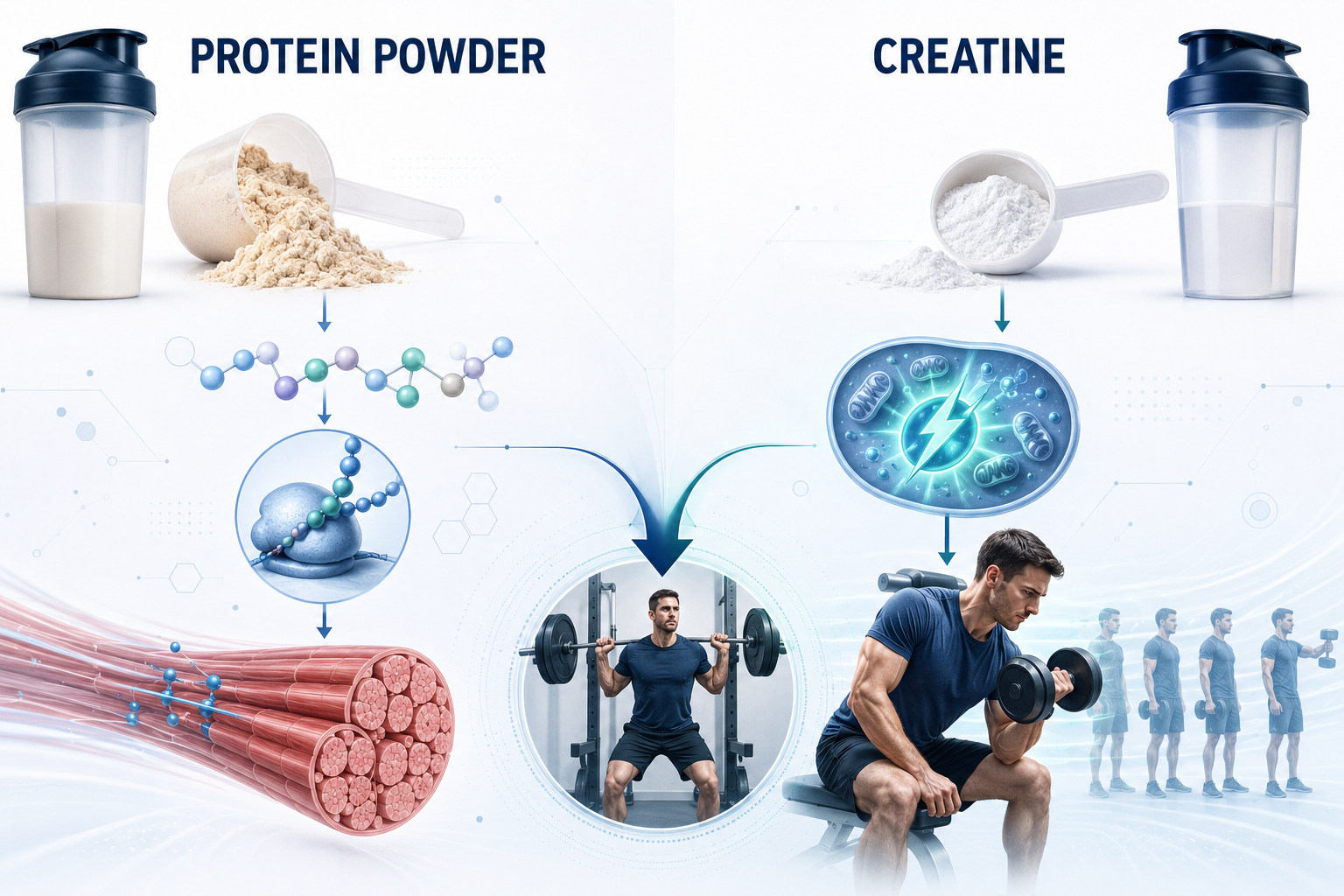
Creatine and protein powder are not alternatives. Protein powder helps you reach your daily protein target; creatine helps support repeated high-intensity training performance. If you currently eat too little protein, fix that first. If your protein intake is already sufficient, creatine will usually provide more additional value than adding another protein shake.
You can take both together, but you do not need either one to build muscle.
Creatine vs Protein Powder: Quick Answer
| Question | Protein powder | Creatine |
|---|---|---|
| Main purpose | Provides dietary protein and amino acids | Raises muscle creatine stores |
| How it supports growth | Helps you meet the nutritional requirement for repair and hypertrophy | Supports strength, repeated efforts, and productive training over time |
| Typical amount | Enough to close the gap in your daily protein intake | 3–5 g of creatine monohydrate daily |
| Calories | Usually about 100–130 kcal per serving | Effectively calorie-free at a normal dose |
| First priority when | Your protein intake is below target | Your protein intake and training fundamentals are already covered |
| Can food replace it? | Yes—protein-rich foods provide the same basic nutrient | Normal food provides some creatine, but usually not a full supplemental dose |
| Can you use both? | Yes. They solve different problems and can be mixed in the same shake. | |
Which Should You Buy First?
Use this order:
- Check your protein intake. If it is consistently too low, protein-rich food or protein powder is the first priority.
- Check your training. Neither supplement compensates for inconsistent resistance training or poor progression.
- Add creatine. Once the nutritional and training foundations are in place, creatine monohydrate is one of the most evidence-supported optional additions.
If budget only allows one product, do not decide based on which container says “muscle growth” more loudly. Decide based on your current bottleneck.
Protein Powder: What It Actually Does
Protein powder is concentrated dietary protein. Whey, casein, soy, pea, and blended plant powders provide amino acids that contribute to your total daily protein intake.
Resistance training creates the reason for muscle to adapt. Adequate dietary protein provides the amino acids used to support repair and new tissue. A large meta-analysis found that protein supplementation can improve gains in strength and fat-free mass during resistance training, with the average benefit levelling off around a total intake of approximately 1.6 g/kg/day. Individual needs and useful targets can still vary.
The important word is total. Protein from a shake is not automatically better than protein from meals. Powder becomes useful when convenience, appetite, time, price per gram, or calorie control makes it difficult to reach your daily protein target with food alone.
You may benefit from protein powder when:
- You regularly finish the day below your protein target.
- You need a portable option after training or during work.
- You are dieting and want more protein for relatively few calories.
- You struggle to fit another full meal into your day.
- You prefer the cost or convenience of powder to another protein-rich meal.
If you already reach an appropriate intake through meat, fish, dairy, eggs, legumes, soy, or other high-quality protein sources, buying protein powder is optional.
Creatine: What It Actually Does
Creatine does not provide protein, essential amino acids, or the raw material needed to reach a protein target. It works through a different pathway.
Supplemental creatine increases the creatine and phosphocreatine stored in muscle. This supports rapid ATP regeneration during short, intense efforts such as hard resistance-training sets. Across weeks and months, the ability to perform slightly more productive work can contribute to improvements in strength and lean mass alongside training.
The most practical protocol is 3–5 g of creatine monohydrate per day. A loading phase can saturate muscle stores faster, but it is not required.
You may benefit from creatine when:
- You perform consistent resistance or high-intensity training.
- Your calorie and protein intake already support your goal.
- You want a well-researched supplement with a relatively low daily cost.
- You understand that the benefit accumulates through consistent use rather than one dramatic workout.
Which Builds More Muscle?
This question does not have one universal winner because the comparison depends on your starting point.
If you are protein-deficient relative to your training needs, adequate protein matters more. Creatine cannot supply missing amino acids. Correcting a major protein shortfall addresses a basic nutritional limitation.
If you already consume enough protein, more powder may add little. Creatine can then offer a separate benefit because it targets training performance rather than increasing an already-sufficient protein intake.
Research supports both protein supplementation and creatine when each is used in an appropriate context. The mistake is interpreting “both work” as “everyone needs both.”
Do You Need Both Creatine and Protein Powder?
No. Four reasonable setups exist:
| Your situation | Sensible choice |
|---|---|
| You reach your protein target and do not want supplements | Neither |
| You struggle to eat enough protein | Protein powder first |
| You reach your protein target and train consistently | Creatine |
| You need help reaching protein and want creatine’s performance benefits | Both |
Supplements should simplify a good plan. They should not become a substitute for building one.
If Protein Intake Is the Gap
If meals do not conveniently provide enough protein, the THG Fit Check below shows one documented whey option from our current UK affiliate partner. It is not a claim that everyone needs protein powder or that this product is universally better than other suitable options.
Read the complete guide to whey protein for muscle growth before deciding whether a powder solves a real problem in your diet.
If Protein and Training Are Already Covered
If your protein intake is sufficient and creatine fits your situation, this THG Fit Check shows the straightforward creatine monohydrate option we currently assess.
Can You Take Creatine and Protein Powder Together?
Yes. You can take creatine and protein powder together, including in the same shake. There is no need to separate them because they perform different functions.
A straightforward routine is:
- Use one serving of protein powder when it helps close your daily protein gap.
- Add 3–5 g of creatine monohydrate daily.
- Take the mixture at a time you can repeat consistently.
- Count the shake’s protein and calories within your normal diet.
The precise timing is less important than meeting your overall protein intake and taking creatine consistently. If you miss creatine occasionally, simply resume your normal dose; see what to do after missing creatine for a few days.
Creatine vs Whey Protein
Whey is simply one type of protein powder. It is rich in essential amino acids, digests efficiently, and is convenient, but it does not become equivalent to creatine because both are sold in tubs.
Other complete or well-formulated protein powders can serve the same basic purpose as whey. Choose based on dietary preference, tolerance, protein content, ingredients, and cost—not the assumption that whey and creatine compete for the same role.
What About Weight Gain and Calories?
Protein powder contains energy because protein provides calories. A typical serving commonly supplies around 20–25 g of protein and roughly 100–130 kcal, depending on the product. Those calories can fit within a muscle-gain, maintenance, or fat-loss diet.
Creatine itself contributes negligible dietary energy at a normal supplemental dose. However, increasing muscle creatine may cause an early increase in body weight related partly to water stored with creatine in muscle. This is not body-fat gain. The separate guide explains creatine, water retention, and scale weight.
How I Apply This Decision Personally
At around 87 kg, I generally aim for roughly 160–190 g of protein during a fat-loss phase. I do not view protein powder as a separate muscle-building requirement. It is a convenient way to close the gap when my meals do not reach that range without adding more food than I want.
I treat the creatine decision separately. Whether I need a shake depends on that day’s diet; whether creatine is useful depends on the longer-term training and supplementation plan. That distinction prevents me from treating two completely different products as competitors.
Your numbers do not need to match mine. Use the free Macro Calculator as a starting estimate, then adjust your intake using body-weight trends, performance, recovery, and your actual goal.
The Bottom Line
Protein powder helps you reach an appropriate protein intake. Creatine supports high-intensity training performance through elevated muscle creatine stores. If protein is insufficient, address protein first. If protein is already covered, creatine usually offers more additional value than another shake.
You can use both, one, or neither. Start with the limitation in your current plan—not the supplement label.
For the broader evidence hierarchy, compare both products within the guide to supplements for muscle growth.
FAQ
Is creatine better than protein powder for muscle growth?
It depends on your current limitation. If your protein intake is too low, reaching an appropriate protein target is the first priority. If protein is already sufficient, creatine may provide more additional value by supporting training performance.
Do I need protein powder if I take creatine?
No. Creatine does not replace dietary protein, but protein powder is only one way to reach your protein target. You can get all of your protein from food if that is practical for you.
Can I put creatine in my protein shake?
Yes. You can mix 3–5 g of creatine monohydrate into a protein shake. Consistent intake matters more than separating the products or taking them at a perfect time.
Should a beginner take creatine or protein powder first?
A beginner should first establish consistent training and adequate nutrition. If protein intake is below target, food or protein powder comes first. Creatine can then be added as an optional, evidence-supported supplement.
Can I build muscle without creatine or protein powder?
Yes. Resistance training, sufficient calories, adequate dietary protein, and recovery can build muscle without either supplement. Both products are tools rather than requirements.
References
- Morton RW, Murphy KT, McKellar SR, et al. A systematic review, meta-analysis and meta-regression of the effect of protein supplementation on resistance training-induced gains in muscle mass and strength in healthy adults. British Journal of Sports Medicine. 2018;52:376–384. PubMed.
- Jäger R, Kerksick CM, Campbell BI, et al. International Society of Sports Nutrition position stand: protein and exercise. Journal of the International Society of Sports Nutrition. 2017;14:20. PubMed.
- Kreider RB, Kalman DS, Antonio J, et al. International Society of Sports Nutrition position stand: safety and efficacy of creatine supplementation in exercise, sport, and medicine. Journal of the International Society of Sports Nutrition. 2017;14:18. PubMed.
- Antonio J, Candow DG, Forbes SC, et al. Common questions and misconceptions about creatine supplementation: what does the scientific evidence really show? Journal of the International Society of Sports Nutrition. 2021;18:13. PubMed.
- Desai I, Candow DG, Chilibeck PD, et al. The effect of creatine supplementation on resistance training-based changes to body composition: a systematic review and meta-analysis. Nutrients. 2024;16:2807. PubMed.