Protein Quality and Digestibility: Does It Matter for Muscle Growth?
TL;DR
- Protein quality scores describe amino acid supply and digestibility, not predicted muscle growth.
- PDCAAS and DIAAS use different methods; a score is not simply the percentage of protein you absorb.
- Do not multiply every food’s protein grams by its score or automatically add 10% for a plant-based diet.
- Use the scores as context when choosing protein sources, then look at your whole diet.
What is protein quality?
Protein quality concerns how a food supplies indispensable amino acids relative to a reference requirement, with an adjustment for digestibility. These are amino acids you need from your diet. The score depends on the reference pattern and the food being assessed.
PDCAAS means Protein Digestibility-Corrected Amino Acid Score. DIAAS means Digestible Indispensable Amino Acid Score. FAO’s 2013 expert report recommended the latter method.1
PDCAAS vs DIAAS
| Feature | PDCAAS | DIAAS |
|---|---|---|
| Digestibility adjustment | Overall protein digestibility, assessed using faecal measurements | Individual indispensable amino acid digestibility at the end of the small intestine |
| Reported upper score | Conventionally capped at 1.0 (100) | Individual food scores can exceed 100 |
| What it describes | Digestibility-adjusted amino acid adequacy | Digestible indispensable amino acid adequacy |
| What it does not predict | How much muscle an individual lifter will gain | |
The calculation is limited by the amino acid with the lowest adequacy relative to the reference pattern. This is why a quality score should not be read as a simple absorption percentage.1
Do you need to calculate “usable protein”?
For ordinary meal planning, keep using the protein grams on food labels. Do not convert a meal with 30 g protein into a smaller number by multiplying it by an isolated food score. That shortcut does not reproduce an assessment of a mixed diet and does not estimate muscle gain.
For example, a lifter eating a varied mix of beans, grains, tofu and other protein foods needs a different practical assessment from someone obtaining most protein from one low-protein staple. Looking up one ingredient’s score does not answer whether either person’s complete day supplies enough protein and essential amino acids.
This guide explains how to interpret scores. For food selection and the training-outcome evidence, use the separate animal versus plant protein comparison. Those are related questions, but they are not the same decision.
Does a better score mean more muscle?
Not automatically. A protein-quality assessment and a resistance-training trial measure different outcomes. Van Vliet and colleagues review how amino acid composition, digestion and the amount consumed can influence the acute muscle protein synthesis response. A short-term response does not by itself establish a long-term hypertrophy advantage for every diet.2
Morton and colleagues’ resistance-training meta-analysis supports the importance of sufficient daily protein. Its estimated intake breakpoint is not an exact threshold for every person and does not prove that all protein sources are interchangeable above a particular intake.3
A simple order for checking your diet
- Check the daily amount. Use our daily protein guide to set a practical starting target rather than chasing a food score.
- Check actual portions. A food can be nutritious without providing a substantial protein serving. Count what you normally eat, not just whether the meal contains a protein ingredient.
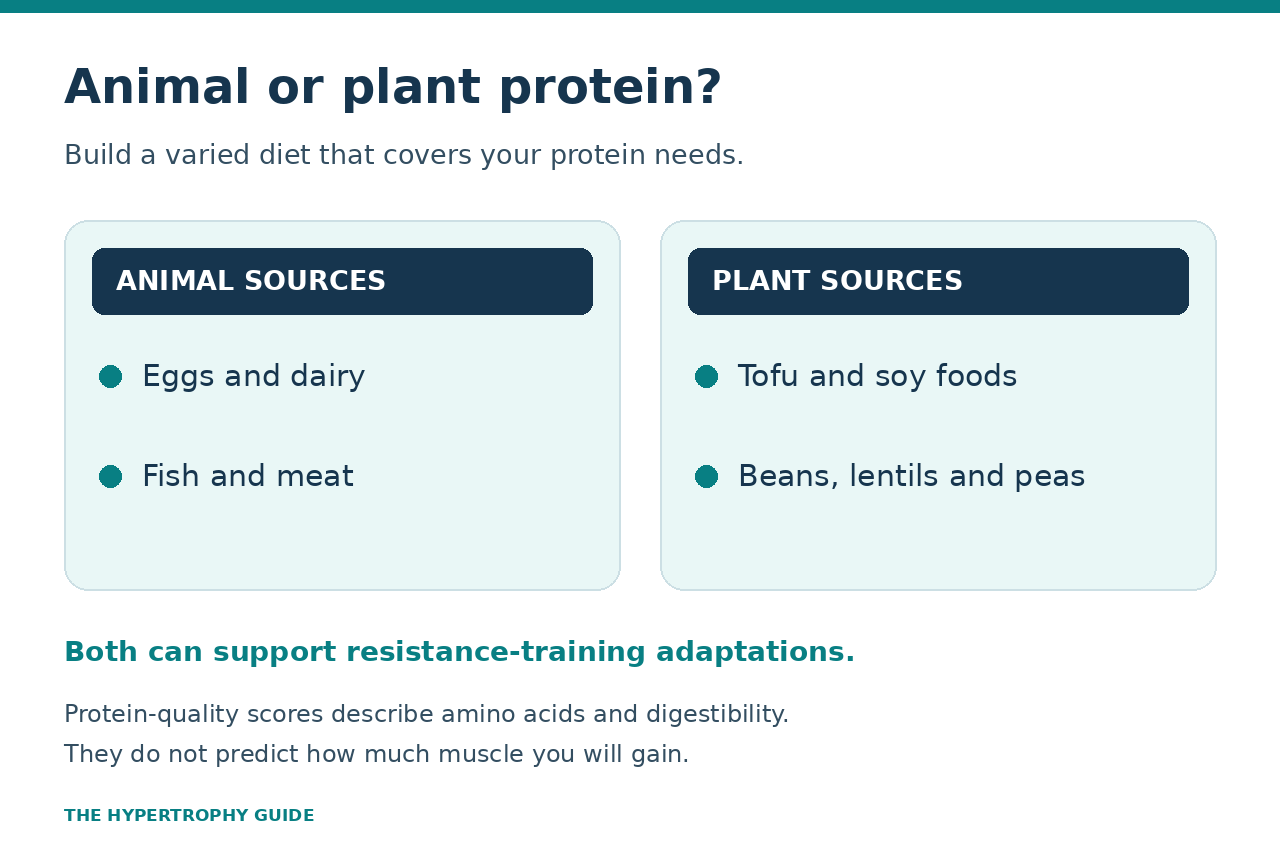
- Look at the range of sources. For plant-based meals, options such as tofu, tempeh, soy foods, legumes and suitable protein products can help build substantial servings. The need for a larger portion or extra protein depends on the diet; there is no universal 10% adjustment.
- Check convenience and tolerance. A theoretically attractive source is of little practical use if you cannot comfortably eat it or keep buying and preparing it.
For example, if a breakfast is mostly cereal with a small splash of milk, the first useful change may be adding a substantial protein food. Calculating the cereal’s exact DIAAS is unlikely to be the most useful first task. This is a meal-planning example, not a claim that a particular breakfast is unsuitable.
See the per-meal protein guide for distribution and the protein hub for related questions. Quality scores provide context; they do not replace a workable diet and progressive training.
References
- FAO. (2013). Dietary protein quality evaluation in human nutrition. FAO Food and Nutrition Paper 92. Expert report.
- van Vliet S, Burd NA, van Loon LJC. (2015). The Skeletal Muscle Anabolic Response to Plant- versus Animal-Based Protein Consumption. Journal of Nutrition. PubMed.
- Morton RW, Murphy KT, McKellar SR, et al. (2018). A systematic review, meta-analysis and meta-regression of the effect of protein supplementation on resistance training-induced gains in muscle mass and strength in healthy adults. British Journal of Sports Medicine. PubMed.