How Much Muscle Can You Gain Naturally?
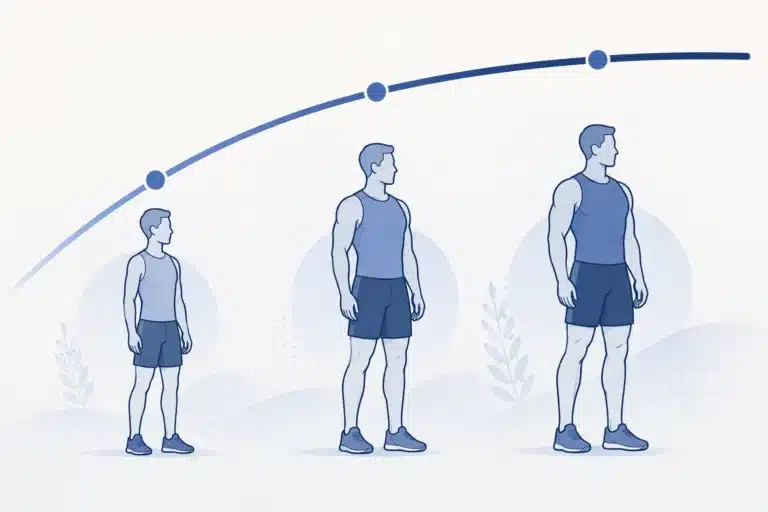
How much muscle can you gain naturally? The honest answer is that no study, calculator or coach can predict your exact lifetime total. Most people build muscle fastest when they are new to effective resistance training, then progress slows as they become more trained. But the amount you ultimately build depends on your starting point, genetics, body size, sex, training quality, nutrition and—most importantly—how many of your years are actually productive muscle-building years.
The commonly repeated claim that most natural men can gain exactly 20–25 lb (9–11 kg) of muscle is too precise. Some will gain less. A previously thin, highly responsive lifter may gain substantially more across a decade. The research supports a slowing curve and enormous individual variation; it does not establish one universal lifetime allowance.
The Short Answer
- Beginners usually have the greatest potential to build muscle quickly.
- Progress slows with training experience, but being advanced does not mean growth becomes impossible.
- Several kilograms of muscle across the first productive years is realistic for many lifters, but no single annual or lifetime number applies to everyone.
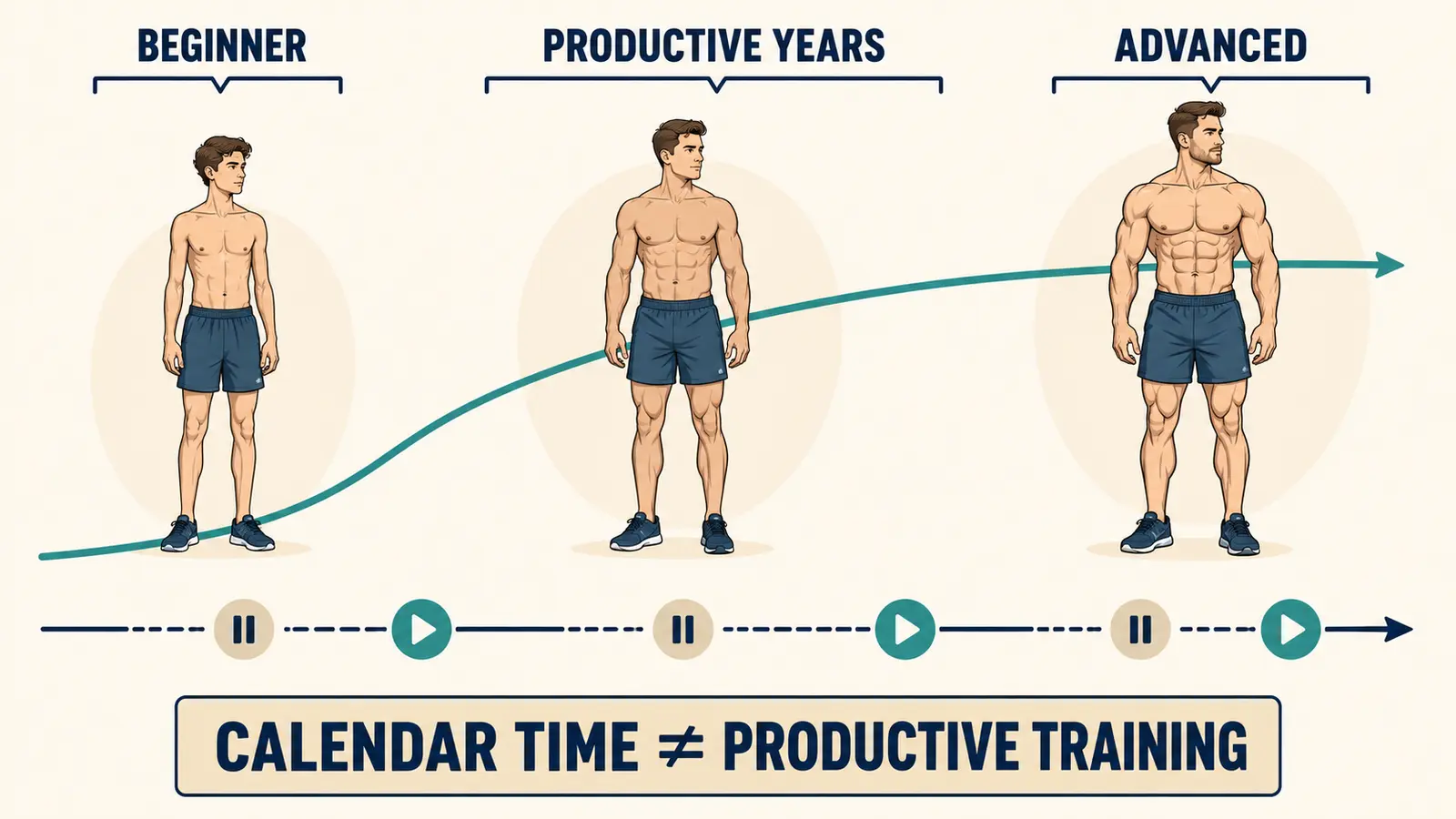
- Fifteen years since your first gym membership may contain far fewer than fifteen years of structured, progressive hypertrophy training.
- Scale weight, lean body mass and fat-free mass are not identical to skeletal muscle gained.
- Your own response across repeated, well-controlled training phases is more informative than a genetic-potential formula.
If you want to describe your current amount of fat-free mass relative to height, use the THG FFMI Calculator. It can provide context for your present physique, but it cannot calculate your genetic ceiling.
Why There Is No Exact Natural Muscle Limit
To establish a true lifetime natural-muscle limit, researchers would need to follow large groups of verified drug-free lifters for decades. Training, nutrition and adherence would need to remain consistently high, and skeletal muscle—not simply bodyweight or fat-free mass—would need to be measured accurately throughout the entire period.
That study does not exist.
Instead, most natural-potential estimates combine shorter resistance-training trials, observations of experienced lifters, body-composition data and coaching heuristics. Each source can provide useful context, but none can tell a 20-year-old exactly how many kilograms of muscle remain available to him or her.
This distinction is often lost online. A rough model becomes a table, the table becomes a promise, and the promise eventually becomes a supposed biological law.
A population average describes a group. A potential estimate predicts an individual. Research is much better at the first task than the second.
Muscle Mass Is Not the Same as Fat-Free Mass
Many studies and body-composition devices report lean body mass or fat-free mass. These measurements include more than contractile skeletal muscle: water, glycogen, organs, connective tissue and bone all contribute.
A calorie surplus, higher carbohydrate intake or creatine use can increase glycogen and water. A new training program can initially create swelling. A DXA or bioelectrical-impedance scan may record part of these changes as additional lean mass even when the equivalent amount of new muscle tissue has not been built.
This does not make body-composition data useless. It means that a claim such as “I gained 4 kg of lean mass” should not automatically be rewritten as “I built 4 kg of muscle.”
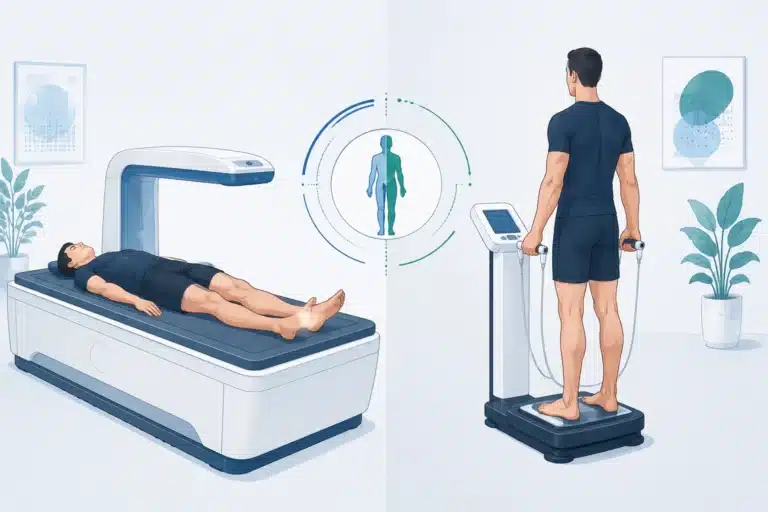
If you use scans to follow this process, compare like with like. THG’s DEXA vs InBody guide explains why the two methods can produce different estimates and how to standardize repeat testing.
What Resistance-Training Research Actually Shows
The strongest consistent finding is not one lifetime number. It is that muscle growth varies greatly between people and generally becomes more difficult as training status increases.
| Study | Participants and duration | Main result | What it means |
|---|---|---|---|
| Ahtiainen et al. (2003) | 8 strength-trained and 8 previously untrained men; 21 weeks | Quadriceps cross-sectional area increased 5.6% in the untrained group and did not significantly increase in the strength athletes. | Training status can strongly influence the amount of measurable growth produced by the same period. |
| Hubal et al. (2005) | 585 men and women; 12 weeks of unilateral arm training | Changes in muscle cross-sectional area ranged from −2% to +59%. | People can respond very differently to a standardized program. |
| Ahtiainen et al. (2016) | 287 previously untrained adults; 20–24 weeks | Average muscle-size change was 4.8%, with individual changes ranging from −11% to +30%. | The average hides a very wide response distribution and measurement uncertainty. |
| Damas et al. (2016) | Previously untrained men followed across a resistance-training program | Early increases in muscle size were influenced by damage and swelling; later changes better represented accumulated hypertrophy. | Short studies and early scans can exaggerate how quickly actual tissue is built. |
| Garthe et al. (2011) | 21 elite athletes; 8–12-week weight-gain phase with 12-month follow-up | The nutrition-guided group increased body mass and measured lean body mass, while individual tissue changes could not be reduced to pure new muscle. | Eating and training deliberately can support gain, but faster scale gain is not a direct muscle measurement. |
Note: These studies used different populations, muscles, protocols and measurement methods. Their percentages cannot be added together or extrapolated linearly into a lifetime total.
How Much Muscle Can You Gain Naturally as a Beginner?
Beginners usually occupy the steepest part of the muscle-gain curve. The training stimulus is new, relatively simple programs can produce progress, and improvements in technique and neural coordination often occur alongside hypertrophy.
That does not justify promising every beginner a fixed number of pounds in year one. A previously underweight 20-year-old man eating enough for the first time is not starting from the same position as an athletic beginner who already developed muscle through sport. Nor will a person missing sessions and protein targets respond like someone completing a supervised program.
If forced into a practical answer, many previously untrained natural lifters can build several kilograms of actual muscle across their first productive years. Some thin, genetically responsive men may eventually add well over 10 kg of fat-free mass at a similar body-fat level. Others will add less. Women generally gain less absolute mass because they begin with less muscle, but research does not support the idea that women are inherently poor relative responders to resistance training.
| Stage | What progress often looks like | Useful time scale | Main mistake |
|---|---|---|---|
| New to effective training | Visible changes, rapid strength improvement and measurable circumference changes | Months | Assuming all weight gained is muscle |
| Intermediate | Progress continues but requires more consistent programming, food and recovery | 6–12 months | Program-hopping when short-term progress slows |
| Advanced | Small improvements that may be difficult to separate from measurement noise | Years | Forcing faster scale gain and mostly adding fat |
This table describes the direction and time scale of progress. It is intentionally not a promise of a fixed number of kilograms per year.
The popular year-by-year models can be useful for setting expectations, but they are coaching heuristics—not validated biological equations. We will examine those models in greater detail in the separate guide to muscle-gain rates by training age.
Why Muscle Gain Slows as You Become More Trained
A beginner is far from his or her adapted state. Almost every competently performed week provides a meaningful new stimulus. Over time, the same loads, sets and exercises become familiar, and a larger or better-organized stimulus is needed to create a smaller adaptation.
Several processes contribute:
- Your existing muscle mass is already adapted to resistance training.
- The muscle-protein-synthesis response becomes shorter and more targeted as training status increases.
- More training may be required to create additional stimulus, but your recovery capacity does not increase without limit.
- Small real changes become harder to distinguish from hydration, glycogen and measurement error.
- Life stress, injuries, dieting phases and inconsistent periods accumulate across the years.
This is why the goal is not to add sets indefinitely. Your productive volume must remain recoverable. THG’s guide to minimum effective volume explains how to find the lowest dose that is actually producing a repeatable upward trend.
Training Age Is Not Calendar Age
I first started taking strength training seriously at roughly 19 or 20 years old. That means I have now been training in some form for around 15–16 years.
But it would be misleading to describe myself as someone with 15–16 perfectly executed years of hypertrophy training.
Some years contained structured programs, consistent food intake and deliberate progression. Other periods involved partying, maintenance training, cuts, changing priorities or simply not knowing enough yet. My first two or three years were part training and part education. Across the full timeline, I would estimate that perhaps six to eight years were genuinely serious, productive muscle-building years.
Your training age is not the number of years since you first touched a barbell. It is the accumulated time you have spent training effectively enough, consistently enough and with sufficient recovery to create adaptation.
This matters when people assume they have “used up” their beginner or intermediate gains. A lifter may have trained for ten calendar years but spent much of that time maintaining, dieting, recovering from injuries or repeating an unproductive program. The person is experienced, but the physique may still have room to respond when the full process finally becomes consistent.
I have experienced this myself. Even after many years of lifting, a long period of structured training and adequate calories produced another noticeable spike in progress. The curve slows, but it does not follow your membership anniversary.
From Roughly 65 kg to Over 100 kg
The Skinny Starting Point
I was always the skinny kid. At 186 cm, I probably weighed somewhere between 65 and 70 kg when strength training first caught my attention.
Around 2010, I attended a Danish sports folk high school and completed a fitness-instructor course. Strength training was much less mainstream than it is now. In my memory, serious gyms belonged to enormous, intimidating men training in dark rooms—not ordinary young people documenting workouts on an app.
One of the people at the school, Peter, seemed incredibly muscular and strong to me. He had muscle everywhere; the rest of us boys had almost none. Seeing him made the result of strength training feel tangible for the first time.
I also remember a girl from high school telling me, “No, Alex, you are too skinny.” She liked me, but that was still how she saw me. I cannot prove how much that single comment affected me, but it probably added fuel to a private promise: I never wanted to be the skinny boy again.
Learning Through Fitness Culture
When I later studied multimedia design, I connected with classmates who lifted and began training with them. In my early twenties—after moving to Islands Brygge—I trained at Fitness World five or six times per week, deliberately bulked and bought a training program and meal plan from a fitness YouTuber.
We did not have today’s ecosystem of polished tracking apps and accessible research summaries. I learned through bodybuilding forums, YouTube videos, experimentation and the people around me.
The problem was that some of the physiques I followed were not natural. I eventually learned that, even though part of me had probably always suspected it. I wanted to believe that following the same program and diet could produce the same body.
I used enhanced physiques as motivation to pursue an outcome that was probably impossible for me naturally. An unreachable target can pull you forward, but it is a poor ruler for deciding whether your own body is good enough.
That period also strengthened the analytical side of my training. If I was not growing, I assumed there must be something I could improve—technique, programming, exercise execution or nutrition. Technique became especially important to me and later shaped how I coached clients as a personal trainer from 2019 to 2025.
The 100 kg Experiment
My most deliberate size experiment came after the coronavirus period and the end of a relationship. I began around 80–82 kg and spent approximately a year and a half to two years pushing my bodyweight upward. At my heaviest, I reached roughly 100–102 kg.
I became larger and stronger, and other serious lifters noticed. But the additional 18–20 kg was obviously not all muscle. I was uncomfortable at the higher body-fat level, and the experience eventually changed the question I was asking.
Instead of “How large can I possibly become?” the more useful question became “How muscular, capable and healthy do I actually want to be?”
The full relationship between that bulk, my FFMI and the famous natural-limit claim is explored in Is FFMI 25 the Natural Limit?.
What Determines Your Natural Muscle Potential?
Genetics matter, but “genetics” is often used as a vague explanation for everything. Natural potential is more usefully viewed as the interaction of several factors.
Your Starting Point
A thin, untrained person has more visible room to add mass than someone who already built muscle through sport or physical work. The same five kilograms would also look different on a person who is 160 cm tall and someone who is 190 cm tall.
Frame and Body Size
Height, skeletal dimensions and starting fat-free mass influence how much tissue a physique can carry and how that tissue looks. Wrist- and ankle-based formulas attempt to use frame size to estimate potential, but they remain approximations rather than personal biological tests.
Individual Responsiveness
The Hubal and Ahtiainen datasets show that standardized programs do not produce standardized bodies. Differences in muscle architecture, fiber characteristics, hormonal environment, recovery and gene expression may all contribute. We cannot yet turn those factors into a reliable consumer calculator.
Training Quality and Recoverable Volume
Potential is not reached simply by waiting long enough. Training must create sufficient mechanical tension, progress over time and remain within what you can recover from. A well-designed program organizes volume, effort, exercise selection and recovery rather than relying on motivation alone. See How to Design a Hypertrophy Training Program for the full framework.
Energy, Protein and Consistency
Under-eating can limit progress, but a larger surplus does not force the body to build muscle at the same rate. As training experience increases, aggressive bulking tends to increase fat more predictably than muscle.
A useful starting point is to meet your daily protein requirement, support training with adequate energy and adjust intake from actual trends. The THG Macro Calculator can provide an initial calorie and macronutrient estimate.
Can FFMI Predict Your Natural Limit?
FFMI describes estimated fat-free mass relative to height. It can help put your current physique into context, especially when bodyweight alone is misleading.
It cannot tell you how much of your fat-free mass is skeletal muscle, how much muscle you will build in the future or whether you have reached your genetic ceiling.
Use FFMI as a description of your current estimated fat-free mass—not as a countdown to your final physique.
Use the FFMI Calculator to calculate raw and normalized FFMI. Then read What Is a Good FFMI? for population and athlete reference ranges.
The number 25 is also frequently presented as a natural ceiling. The original research does not justify using it as an individual verdict, which is why THG treats FFMI 25 as a historical reference rather than a biological limit.
FFMI describes where you are now; it does not forecast your rate of progress. For realistic short-term expectations, see How Much Muscle Can You Gain in a Year?.
How to Estimate Your Own Remaining Potential
You cannot measure your genes directly, but you can run a far more informative experiment than entering your wrist circumference into a formula.
Use Your Own Response as the Test
- Keep your program stable long enough to evaluate it. Avoid changing the main exercises and weekly structure every few weeks.
- Train with measurable progression. Track loads, repetitions, effort and exercise execution.
- Support the goal nutritionally. Eat enough protein and use a controlled calorie intake instead of forcing rapid weight gain.
- Standardize measurements. Compare morning bodyweight averages, waist and limb circumferences, photos and body-composition estimates under similar conditions.
- Judge trends across months. An advanced lifter cannot determine muscle growth from one week, one scan or one unusually good workout.
- Adjust one major variable at a time. If performance and measurements remain flat, review adherence, stimulus, recovery and calories before concluding that genetics ended the process.
Strength is useful evidence, but it is not a direct muscle measurement. Technique and neural adaptation can make you stronger without equivalent hypertrophy. Conversely, small physique changes can occur while a specific lift stalls.
The strongest practical assessment combines multiple signals:
- Long-term load or repetition progress
- Standardized circumference measurements
- Comparable progress photos
- Bodyweight and waist trends
- FFMI or body-composition estimates interpreted with their error
- Your ability to recover and repeat productive training
If several of these improve across a six- to twelve-month period, you are still adapting. You do not need a calculator’s permission to continue.
A Better Goal Than Your Maximum
When I was younger, knowing that a fitness role model was probably enhanced would not necessarily have stopped me from using his physique as motivation. There can be value in a goal that sits beyond what you are likely to reach. It can raise your standards and keep you curious.
But an impossible goal becomes harmful when it is also the standard used to judge every real result.
I would never use anabolic steroids, partly because of the health risks and partly because I do not believe I would handle the psychological return to a smaller “normal” physique well. Today, protecting my relationship with training and my body matters more than maximizing a number.
I no longer have the same level of body dysmorphia I experienced when being muscular felt central to my value. I still enjoy improving my physique, and a small part of that old mindset probably remains. But training now also serves health, capability and enjoyment.
Your theoretical maximum is not automatically your best bodyweight, your preferred appearance or the point at which training adds the most to your life.
That is the practical answer to how much muscle you can gain naturally: probably more than you can accurately predict, less than an enhanced comparison may imply, and only as much as you are willing to pursue within the life and body you actually want.
Frequently Asked Questions
How much muscle can a natural lifter gain in total?
There is no scientifically established universal total. Many natural lifters can build several kilograms of muscle, and thin, highly responsive individuals may add substantially more than 10 kg of fat-free mass across many productive years. Fat-free mass is not identical to skeletal muscle, and individual outcomes vary widely.
Can a beginner gain 10 kg of muscle in one year?
That would be an unusually large amount of verified skeletal muscle. A thin beginner may gain substantial bodyweight and fat-free mass during the first year, but part of the change can be fat, water, glycogen, connective tissue and measurement error. Do not treat 10 kg as a normal promise.
How long does it take to reach your natural limit?
There is no fixed timeline. Progress usually slows across years of effective training, but calendar years do not equal productive training years. Most lifters approach their potential gradually rather than reaching a clearly identifiable stopping point.
Can advanced natural lifters still build muscle?
Yes. The expected rate is slower, and small changes are harder to measure, but advanced does not mean incapable of further hypertrophy. Better programming, renewed consistency, adequate energy or a previously neglected muscle group can still produce progress.
Does gaining weight faster build muscle faster?
Not in a one-to-one relationship. Adequate energy can support training and growth, but aggressive surpluses increase body fat more reliably than they accelerate muscle gain—especially in experienced lifters.
Can wrist size predict natural muscle potential?
Frame size can provide context, and several popular formulas use wrist and ankle circumference. These formulas are rough models based on group observations; they cannot measure your personal genetic ceiling.
Can FFMI tell me how much muscle I have left to gain?
No. FFMI estimates current fat-free mass relative to height. It does not isolate skeletal muscle or predict future response. Use it as one descriptive metric alongside performance, measurements and photos.
How do I know whether I am still building muscle?
Look for agreement across multiple long-term signals: improved performance, circumference changes, standardized photos, bodyweight and waist trends, and body-composition estimates interpreted cautiously. One scan or one week is not enough.
References
- Ahtiainen JP, Pakarinen A, Alen M, Kraemer WJ, Häkkinen K. Muscle hypertrophy, hormonal adaptations and strength development during strength training in strength-trained and untrained men. Eur J Appl Physiol. 2003;89(6):555–563. PubMed.
- Hubal MJ, Gordish-Dressman H, Thompson PD, et al. Variability in muscle size and strength gain after unilateral resistance training. Med Sci Sports Exerc. 2005;37(6):964–972. PubMed.
- Ahtiainen JP, Walker S, Peltonen H, et al. Heterogeneity in resistance training-induced muscle strength and mass responses in men and women of different ages. Age. 2016;38(1):10. PubMed.
- Damas F, Phillips SM, Lixandrão ME, et al. Resistance training-induced changes in integrated myofibrillar protein synthesis are related to hypertrophy only after attenuation of muscle damage. J Physiol. 2016;594(18):5209–5222. PubMed.
- Damas F, Phillips SM, Lixandrão ME, et al. An inability to distinguish edematous swelling from true hypertrophy still prevents a completely accurate interpretation of the time course of muscle hypertrophy. Eur J Appl Physiol. 2016;116(2):445–446. PubMed.
- Garthe I, Raastad T, Sundgot-Borgen J. Long-term effect of nutritional counselling on desired gain in body mass and lean body mass in elite athletes. Appl Physiol Nutr Metab. 2011;36(4):547–554. PubMed.
- Morton RW, Murphy KT, McKellar SR, et al. A systematic review, meta-analysis and meta-regression of the effect of protein supplementation on resistance training-induced gains in muscle mass and strength in healthy adults. Br J Sports Med. 2018;52(6):376–384. PubMed.
- Kouri EM, Pope HG Jr, Katz DL, Oliva P. Fat-free mass index in users and nonusers of anabolic-androgenic steroids. Clin J Sport Med. 1995;5(4):223–228. PubMed.