Leg Curl for Muscle Growth: Seated vs Lying, Form & Reps
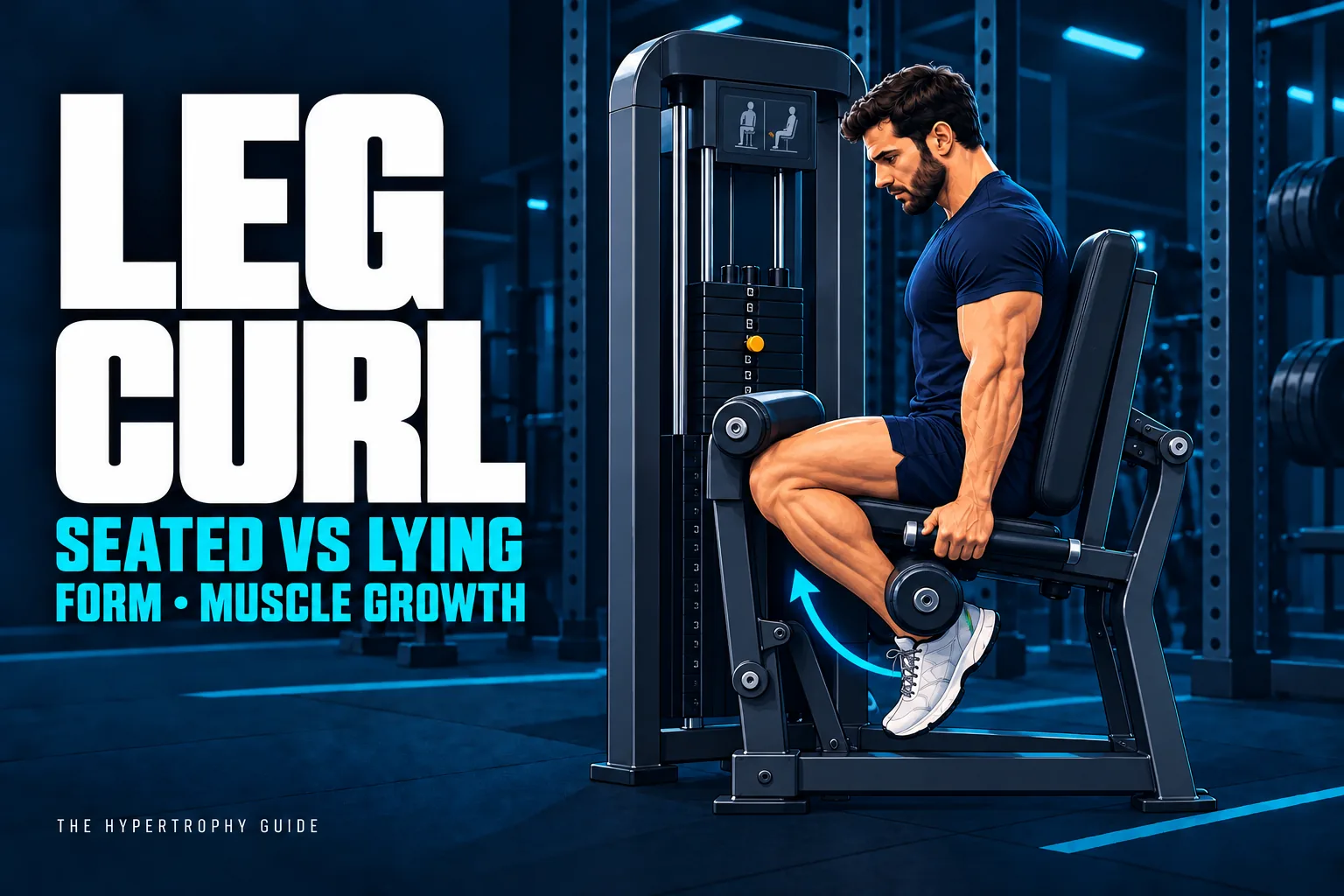
The leg curl trains your hamstrings by bending the knee against resistance. Seated leg curls are a strong first choice when the machine fits comfortably, but lying leg curls can also build muscle. A secure setup, controlled return and repeatable range matter more than simply moving the heaviest stack.
What Muscles Does the Leg Curl Work?
Leg curls primarily train the hamstrings: the semitendinosus, semimembranosus and both heads of the biceps femoris. These muscles contribute to bending the knee. Most also cross the hip; the short head of the biceps femoris does not.
This makes a leg curl a useful partner to a Romanian deadlift. The curl provides direct knee-flexion work, while the RDL trains a hip hinge. They are complementary movements rather than interchangeable versions of the same exercise.
For a complete lower-body session, combine your hamstring work with suitable knee-dominant training, such as a leg press. The leg-training guide explains how those pieces fit together.
Seated vs Lying Leg Curl: Which Is Better?
In a 12-week study, 20 healthy adults trained one leg with seated curls and the other with prone curls. Both conditions increased hamstring size, but whole-hamstring volume increased more with seated training: approximately 14% versus 9%. The advantage appeared in the muscles crossing both hip and knee, not the short head of the biceps femoris.1
The seated position places the hip-crossing hamstrings at longer lengths. This is a useful reason to favor seated curls when both options fit equally well. It is not proof that every seated machine beats every lying machine, or a prediction of your individual results.
| Variation | Practical choice | Check first |
|---|---|---|
| Seated leg curl | A strong default for direct hamstring work. | Knee alignment, secure thigh pad and a comfortable starting position. |
| Lying leg curl | A useful option when it fits better, is available or adds variety you enjoy. | Keep the pelvis supported and avoid arching the back to finish reps. |
How to Set Up and Perform a Leg Curl
Seated leg curl
- Adjust the seat. Line the side of your knee up with the machine’s marked pivot as closely as the design allows. Follow the machine’s setup instructions.
- Secure the pads. Position the working roller behind the lower legs, above the heels. Lower the thigh restraint until you are secure without uncomfortable pressure on the kneecaps.
- Choose the start position. Begin near comfortable knee extension. Do not force the knees beyond straight to chase a bigger stretch.
- Curl with intent. Hold the handles and pull the heels down and back while keeping the thighs and pelvis stable. Move purposefully without jerking.
- Control the return. Let the knees extend under control to the same starting position. Avoid dropping the stack or resting passively between reps.
Lying leg curl
Adjust the roller behind the lower legs above the heels, align the knees with the pivot and settle your hips against the support. Hold the handles, bend the knees and return under control. Use the range you can manage without lifting the pelvis or increasing your lower-back arch to move the weight.
Machine designs differ. If you cannot find a comfortable position after adjusting the settings and load, use another machine or variation rather than forcing the fit.
Range of Motion, Forward Lean and Partial Reps
Should you lean forward in a seated leg curl?
A small forward lean from the hips may change how the stretch feels. Use it only if you can keep the pelvis secure and the machine still supports the movement. Folding through the lower back is not the same as increasing hip flexion.
The seated-versus-lying study did not test an extra forward lean against a normal seated setup. Do not treat leaning farther forward as a proven way to get additional growth.
What about the last few shortened reps?
Use a consistent full, comfortable range for your main repetitions. Technical failure is the point where you can no longer complete another repetition to that standard.
Record any partial reps separately from your full-range reps. Changing the torso position or shortening the curl changes the task, so those extra repetitions should not be counted as proof that your normal full-range performance improved. Beginners can simply stop at technical failure or earlier.
Leg Curl Sets, Reps and Progression
| Use | Working sets | Reps |
|---|---|---|
| General starting point | 2–3 | 10–15 |
| Heavier seated curls with established control | 2–3 | 8–12 |
| Lying curls when heavier loads disrupt position | 2–3 | 12–15, with a lighter load |
Choose a narrower range such as 10–12 or 12–15 if that makes tracking easier. Rest long enough to repeat a controlled set; roughly 90–120 seconds is a practical starting point, with more time if needed.
While learning, stop with a few controlled repetitions left. Once technique is established, finishing most sets with about 1–3 reps in reserve is a practical default. An occasional final seated set to technical failure is an option, not a requirement.
A simple progression rule
For 3 sets of 10–12, build toward 12 controlled reps in each set at the intended effort. Then try the next manageable load and build the repetitions again. Keep the machine settings, torso position and range consistent. If the increase makes you lift your hips or cut the range substantially, return to the previous load.
Where should leg curls go in a workout?
They often fit after your main lower-body lifts. Move them earlier if hamstrings are a priority, while accounting for fatigue before later exercises. Include these sets within your overall hamstring workload rather than automatically adding them on top.
See the upper/lower workout guide for examples of combining curls with compound leg work.
Common Leg Curl Mistakes
- Skipping the setup: check the pivot, roller, seat and restraint before increasing weight.
- Dropping the negative: control the return instead of letting the load snap the knees toward straight.
- Moving the whole body: reduce the load when hip lifting or torso movement becomes necessary to complete the curl.
- Shortening every repetition: establish a repeatable range before experimenting with extended sets.
- Chasing stretch at any cost: a strong muscular stretch is different from forcing a painful joint position.
Extra equipment is not the first fix for an uncomfortable leg curl. Start with the machine settings, range and load. This exercise does not require straps, a lifting belt or special shoes.
Frequently Asked Questions
Are seated leg curls better than lying leg curls?
Seated curls have supportive research and are Alex’s preferred default. Lying curls remain a useful muscle-building exercise, especially when that machine fits you better.
Do leg curls replace Romanian deadlifts?
They train a different movement: knee flexion rather than a hip hinge. Both can fit within a hamstring program, depending on your available time and total workload.
Should I straighten my knees between repetitions?
Return toward your comfortable straight-leg position under control. Do not force hyperextension, slam into the stop or relax completely between repetitions.
Should every set reach failure?
No. Build control first. Training close to your technical limit is different from making every set an extended effort with partial repetitions.
Can I use lying curls if there is no seated machine?
Yes. Adjust the machine, keep your pelvis supported and choose a load that allows controlled repetitions. You do not need to wait for a different machine to train your hamstrings.
Explore more movements in the THG exercise library.
Reference
- Maeo S, et al. Greater Hamstrings Muscle Hypertrophy but Similar Damage Protection after Training at Long versus Short Muscle Lengths. Medicine & Science in Sports & Exercise. 2021;53(4):825–837. Read study.