Cable Fly for Muscle Growth: Height, Technique & Reps
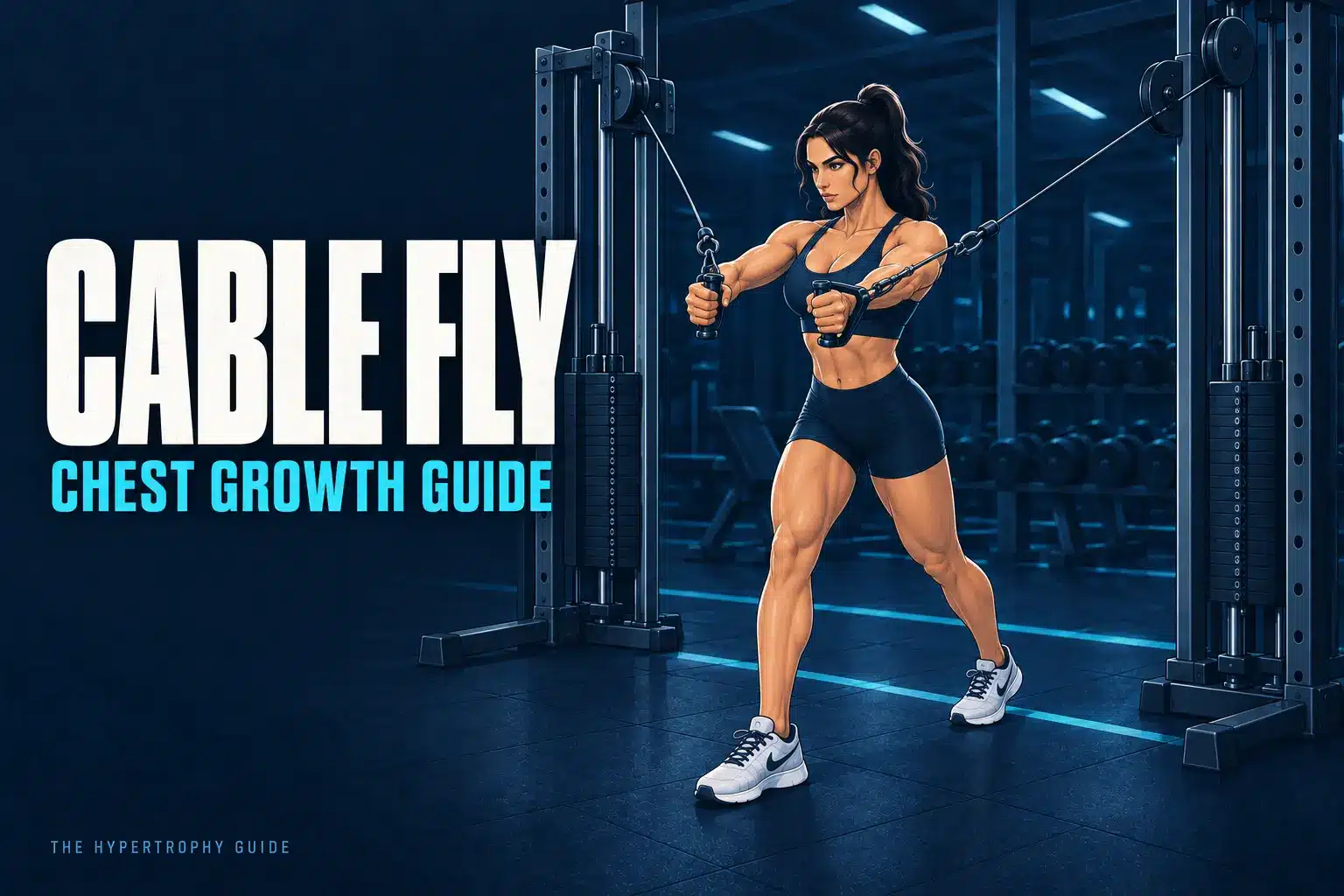
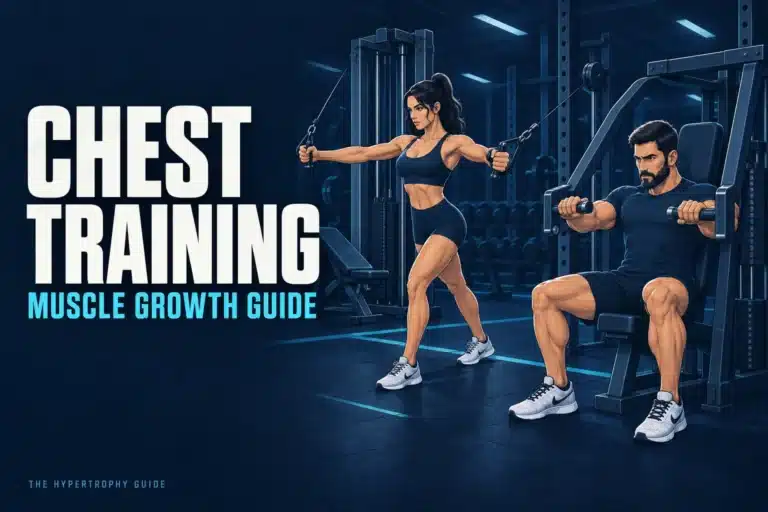
The cable fly is a direct chest exercise that is easy to adjust and difficult to standardise badly. Pulley height can change the arm path, but there is no magical setting that isolates an “inner chest.”
What Muscles Does the Cable Fly Work?
The defining action is horizontal adduction: bringing the upper arms toward one another across the body. The hands are simply attachment points. Thinking about the upper arms moving around the ribcage is often more useful than trying to clap the handles together.
A fly does not isolate the inner chest. The pectoralis fibres shorten across their full length, and no separate medial chest muscle exists. Cables can maintain external resistance near the shortened position better than a dumbbell fly, but the sensation of squeezing is not evidence of uniquely local growth.
What Pulley Height Should You Use?
| Setup | Arm path | Practical use |
|---|---|---|
| Mid-height | Mostly horizontal | Strong general starting point |
| Low-to-high | Upward and inward | Can complement clavicular-focused pressing |
| High-to-low | Downward and inward | Alternative sternocostal-focused path |
These descriptions are useful programming cues, not proof that each setting isolates a separate chest compartment. Choose the path that gives you a comfortable stretch, stable torso and clear chest limitation. A small change in pulley height matters less than a large change in technique or effort.
How to Perform a Cable Fly
- Set both pulleys evenly. Begin around mid-chest or shoulder height and adjust after testing the path.
- Take a stable stance. Step forward enough to clear the stacks and use a split or staggered stance without leaning excessively.
- Set a soft elbow bend. Keep the angle nearly constant instead of turning the movement into a press.
- Open into a controlled stretch. Let the upper arms travel behind the torso only as far as your shoulders remain comfortable and organised.
- Sweep the arms together. Move in a broad arc until the hands meet or slightly cross, depending on the handles and cable line.
- Return slowly. Resist the cables rather than allowing the stacks to pull the shoulders backward.
Should the hands cross?
They can, but they do not have to. Crossing may extend the shortened position when independent handles and cable spacing allow it. Alternate which hand passes in front if you use a noticeable crossover, and do not rotate the torso to create extra range.
Should you keep the shoulder blades pinned?
Keep the ribcage and shoulder girdle controlled without forcing the shoulder blades into an extreme fixed position. Normal scapular movement can occur as the arms travel, especially near the shortened position.
Standing vs Seated vs One-Arm Cable Fly
| Variation | Advantage | Limitation |
|---|---|---|
| Standing bilateral | Fast setup and flexible arm path | Torso movement can hide fatigue |
| Seated bilateral | More external stability | Bench placement may restrict the cable line |
| Single-arm | Easy to align the cable and reach across the body | Takes longer and requires anti-rotation control |
| Pec deck | Highly stable and easy to progress | Machine path may not suit every shoulder |
There is no universal winner. The one-arm variation is useful when the machine is narrow, the handles collide or one shoulder needs a slightly different path. A pec deck can fill the same programming role when it fits comfortably.
Sets, Reps and Progression
| Use | Sets × reps | Effort | Rest |
|---|---|---|---|
| After pressing | 2–4 × 10–20 | 1–3 RIR | 60–120 sec |
| Chest-priority isolation | 3–4 × 8–15 | 1–2 RIR | 90–150 sec |
| Technique introduction | 2–3 × 12–15 | 3–4 RIR | 60–120 sec |
Moderate and higher repetitions usually suit the cable fly because they reduce the need for large weight-stack jumps and make it easier to preserve the arm path. Muscle growth can occur across a broad range of loads when sets are sufficiently challenging.1
Use double progression. Select a range such as 12–18 repetitions. When all sets reach 18 with the same pulley height, elbow angle and stretch, increase the stack by the smallest amount. If the jump is too large, add a small magnetic plate or use additional repetitions before progressing.
Place the fly after presses in a conventional workout. It can also come first when you deliberately want direct chest work with little triceps fatigue, but pre-fatiguing will usually reduce later pressing performance. See the complete chest-training guide for full programmes.
Common Mistakes
Frequently Asked Questions
Are cable flies good for muscle growth?
Yes. They provide direct chest work with little dynamic triceps involvement and can be progressed like any other resistance exercise.
Are cables better than dumbbells?
Not universally. Cables maintain external resistance through more of the arc; dumbbells are simple and widely available. Comfort and progression matter more.
Should cable flies be high or low?
Mid-height is a reliable default. Use low-to-high or high-to-low when that path feels better or complements the rest of your programme.
How far should I stretch?
Stop at the deepest point where your shoulder remains comfortable, the elbow angle stays stable and you can reverse the movement without bouncing.
Bottom Line
The cable fly is a flexible direct-chest exercise, not an inner-chest trick. Choose a comfortable cable line, keep the elbow angle nearly constant, use a controlled stretch and progress repetitions or load without allowing torso movement to take over.
References
- Schoenfeld BJ, et al. Loading recommendations for muscle strength, hypertrophy, and local endurance. Sports. 2021.
- Pallarés JG, et al. Effects of range of motion on resistance training adaptations. Scand J Med Sci Sports. 2020.
- Refalo MC, et al. Influence of resistance training proximity-to-failure on skeletal muscle hypertrophy. Sports Med. 2023.