Romanian Deadlift for Muscle Growth: Technique, Muscles & Programming
The Romanian deadlift is a strong choice for training the hamstrings, gluteus maximus and hip hinge. It is most useful when you can keep the load close, control the lowering phase and stop at the deepest position your current mobility allows without losing spinal or pelvic position.
What Muscles Does the Romanian Deadlift Work?
The Romanian deadlift primarily trains the muscles that extend the hip and resist the torso folding forward. The hamstrings work at long muscle lengths as the hips move back, while the gluteus maximus contributes to hip extension as you return to standing. The spinal erectors and upper-back muscles work isometrically to maintain the position of the trunk and keep the bar close.
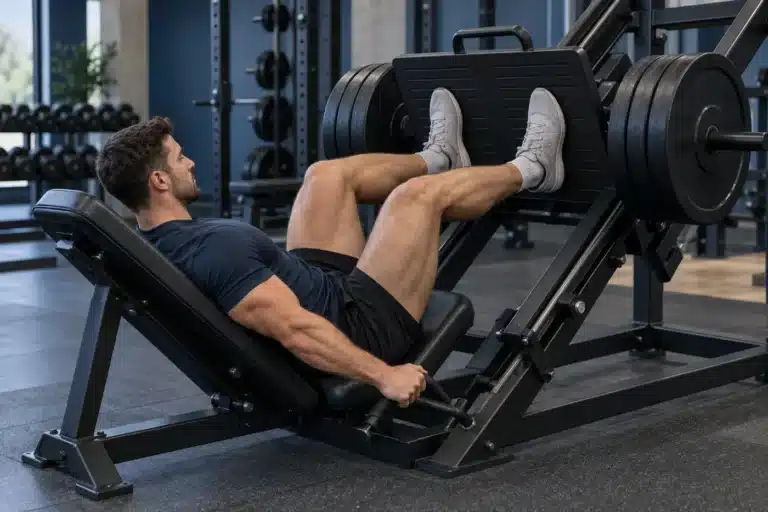
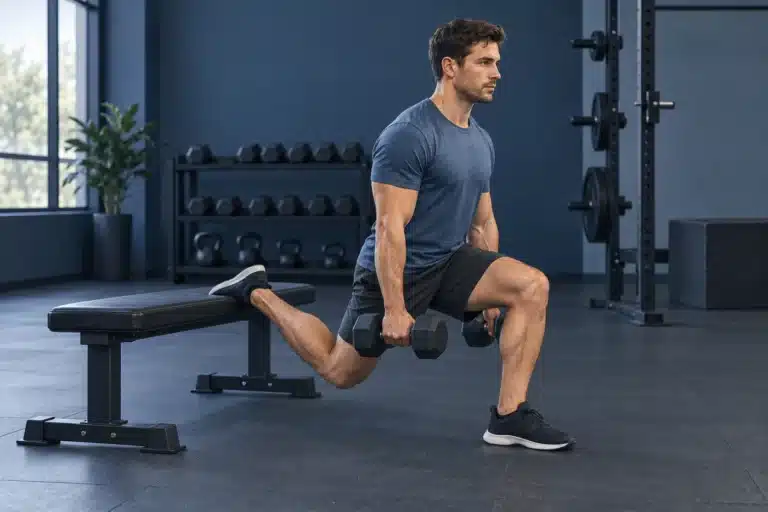
The knees remain slightly flexed, but the exercise does not involve enough knee extension to make it a complete quadriceps exercise. If your programme needs more direct quad work, combine it with a knee-dominant movement such as the leg press or a unilateral option such as the Bulgarian split squat.
Is it a hamstring or glute exercise?
It is both. Small technique differences may change what you feel, but there is no clean switch that turns the Romanian deadlift into a “hamstring-only” or “glute-only” exercise. A controlled hinge with meaningful hip flexion loads both muscle groups. Your individual proportions, mobility, setup and training history influence where you feel it most.
Acute electromyography studies often report high hamstring activity during Romanian deadlift variations, but EMG is not a direct measure of long-term muscle growth. It is better used to understand which muscles contribute than to declare one exercise universally superior.1, 2
How to Perform a Romanian Deadlift
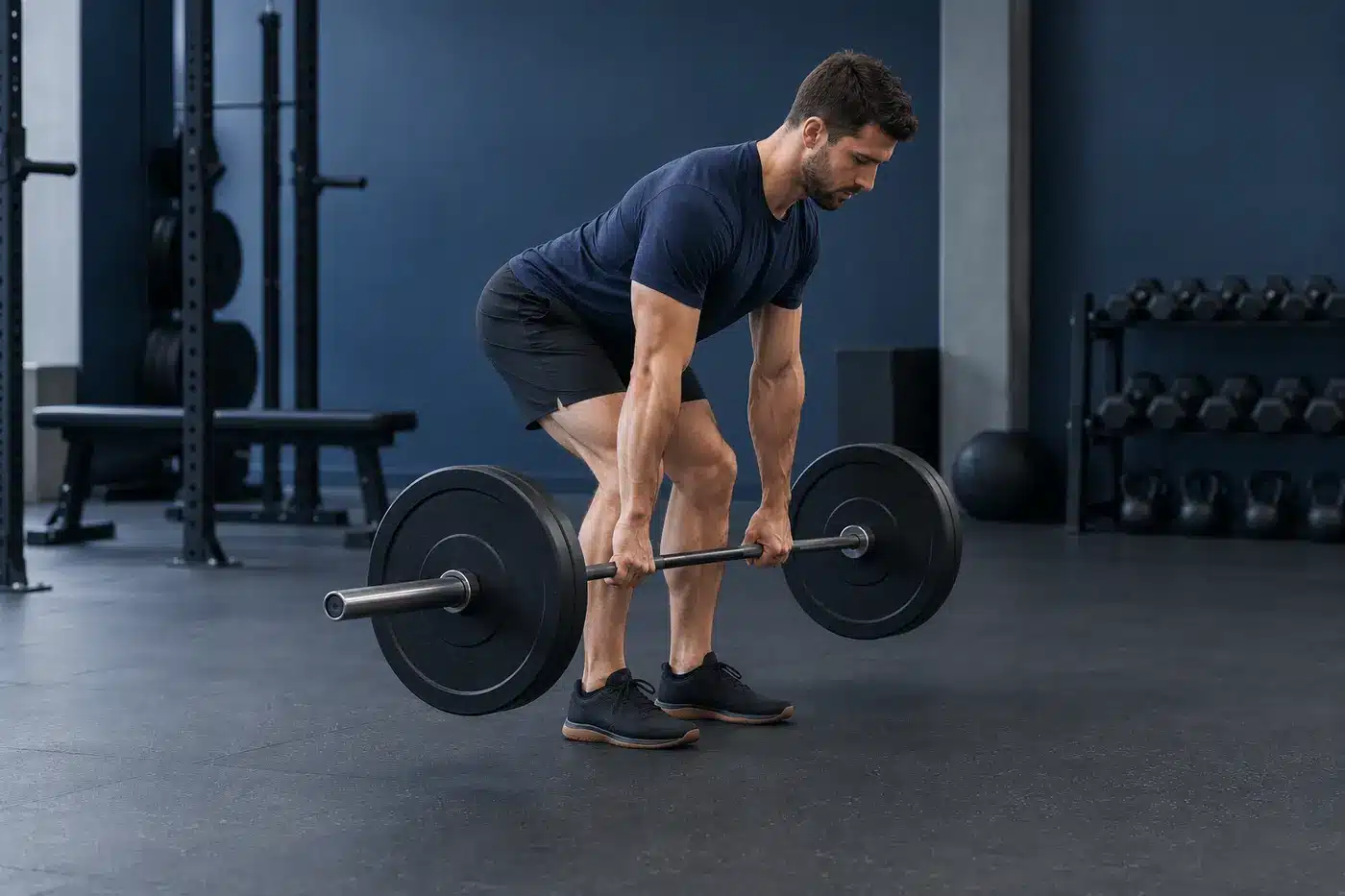
- Start tall. Hold the bar around hip width with your feet roughly hip width apart. Brace your trunk and set your shoulders naturally rather than forcing an exaggerated lean-back position.
- Unlock the knees. Use a small amount of knee flexion and keep it relatively stable as the repetition continues.
- Send the hips back. Imagine closing a car door with your hips. Let the torso incline as the hips travel behind you.
- Keep the bar close. Slide it down the thighs and shins. A bar drifting forward creates a longer lever and usually makes the lift harder on the lower back.
- Stop at your usable depth. End the lowering phase when you have a strong hamstring stretch and can no longer hinge farther without the pelvis tucking, the back rounding or the bar drifting away.
- Stand by extending the hips. Push the floor away and bring the hips forward. Finish tall without leaning back or hyperextending the lower spine.
How Low Should You Go?
The floor is not the target. In an RDL, the correct depth is the deepest position you can reach with a controlled hinge and a close bar path. For one lifter that may be just below the knees; for another it may be mid-shin. Longer arms, shorter femurs and greater hip mobility can all make the bar travel lower without indicating better technique.
Trying to touch the plates to the floor often changes the exercise. The knees bend more, the pelvis may tuck under, and the back may round to create extra range. More range of motion can be useful when it comes from the target joints and remains controlled, but additional bar travel is not automatically productive range.3
Should your back be perfectly flat?
The practical aim is a stable, repeatable trunk position—not a visually perfect geometric line. Small individual differences are normal. What matters is that you can control the load, avoid an unplanned change in position near the bottom and progress without persistent pain. If the lift repeatedly turns into a rounded-back pull despite lighter loading, shorten the range and rebuild the hinge.
Romanian Deadlift vs Stiff-Leg Deadlift
| Feature | Romanian deadlift | Stiff-leg deadlift |
|---|---|---|
| Knee position | Soft bend maintained through the rep | Usually straighter knees |
| Starting point | Commonly begins from standing or the rack | May begin from the floor or standing |
| Practical feel | Balanced hip hinge with substantial hamstring and glute loading | Often creates a stronger hamstring stretch and may require less load |
| Best choice | The variation you can control and progress comfortably | The variation you can control and progress comfortably |
Exercise names are not always used consistently. Judge the movement by what the hips, knees, trunk and bar are actually doing rather than the label alone.
Sets, Reps and Progression for Muscle Growth
The RDL creates considerable local fatigue and can be technically demanding, so it rarely needs very high set numbers in a single session. Start with enough work to progress, then add volume only if recovery and performance support it.
| Goal | Sets × reps | Effort | Rest |
|---|---|---|---|
| Technique practice | 2–3 × 6–8 | 3–4 RIR | 2–3 min |
| Hypertrophy default | 2–4 × 6–12 | 1–3 RIR | 2–4 min |
| Higher-rep option | 2–3 × 10–15 | 1–3 RIR | 2–3 min |
Use double progression: choose a repetition range, keep the technique standard fixed and add repetitions until all work sets reach the top of the range. Then increase the load by the smallest practical amount and repeat. Track proximity to failure with the guide to reps in reserve.
One or two weekly exposures are enough for most programmes. The RDL can appear early in a lower-body session when it is a priority, or after a squat or leg press when the knee-dominant lift is the main goal. Count it as demanding work when planning your total weekly training volume.
Common Romanian Deadlift Mistakes
When Should You Choose Another Exercise?
The RDL is useful, not mandatory. A machine hinge, 45-degree back extension, cable pull-through or another deadlift variation may be easier to load or tolerate. Persistent sharp pain, radiating symptoms or a loss of strength that does not resolve are reasons to stop and seek appropriate professional assessment.
Exercise selection should match the goal, your structure, available equipment and the rest of the programme. See the broader guide to choosing exercises for hypertrophy.
Frequently Asked Questions
Do Romanian deadlifts build hamstrings?
They can. The hamstrings work across the hip while lengthening during the lowering phase. The exercise is best paired with a knee-flexion movement such as a leg curl if complete hamstring development is the goal.
Should I feel Romanian deadlifts in my lower back?
The spinal erectors work to hold the trunk, so some muscular effort is normal. Sharp pain, radiating symptoms or the lower back consistently becoming the only limiting factor are not goals. Reduce the load or range and review the hinge.
Are dumbbell Romanian deadlifts effective?
Yes. Dumbbells can be easier to learn and useful when barbell loading is unnecessary. The main limitation is that grip or available dumbbell weight may cap progression sooner.
How many Romanian deadlift sets should I do?
Two to four hard sets in a session is a practical starting range. Weekly needs depend on the rest of your hamstring and glute training, recovery and progression.
Do I need to touch the floor?
No. Most lifters should stop around knee to mid-shin height, wherever the controlled hip hinge ends.
Bottom Line
The Romanian deadlift is a productive hamstring and glute exercise when the repetition is governed by the hip hinge rather than an arbitrary bar depth. Keep the bar close, preserve a repeatable knee bend, use the deepest controlled range available to you and progress the load only while that standard remains intact.
References
- Martín-Fuentes I, et al. Electromyographic activity in deadlift exercise and its variants: a systematic review. PLoS One. 2020.
- Lee S, et al. An electromyographic and kinetic comparison of conventional and Romanian deadlifts. J Exerc Sci Fit. 2018.
- Pallarés JG, et al. Effects of range of motion on resistance training adaptations: a systematic review and meta-analysis. Scand J Med Sci Sports. 2020.
- Coratella G, et al. An electromyographic analysis of Romanian, step-Romanian, and stiff-leg deadlift. Int J Environ Res Public Health. 2022.