Hip Thrust for Muscle Growth: Form, Setup & Comfort
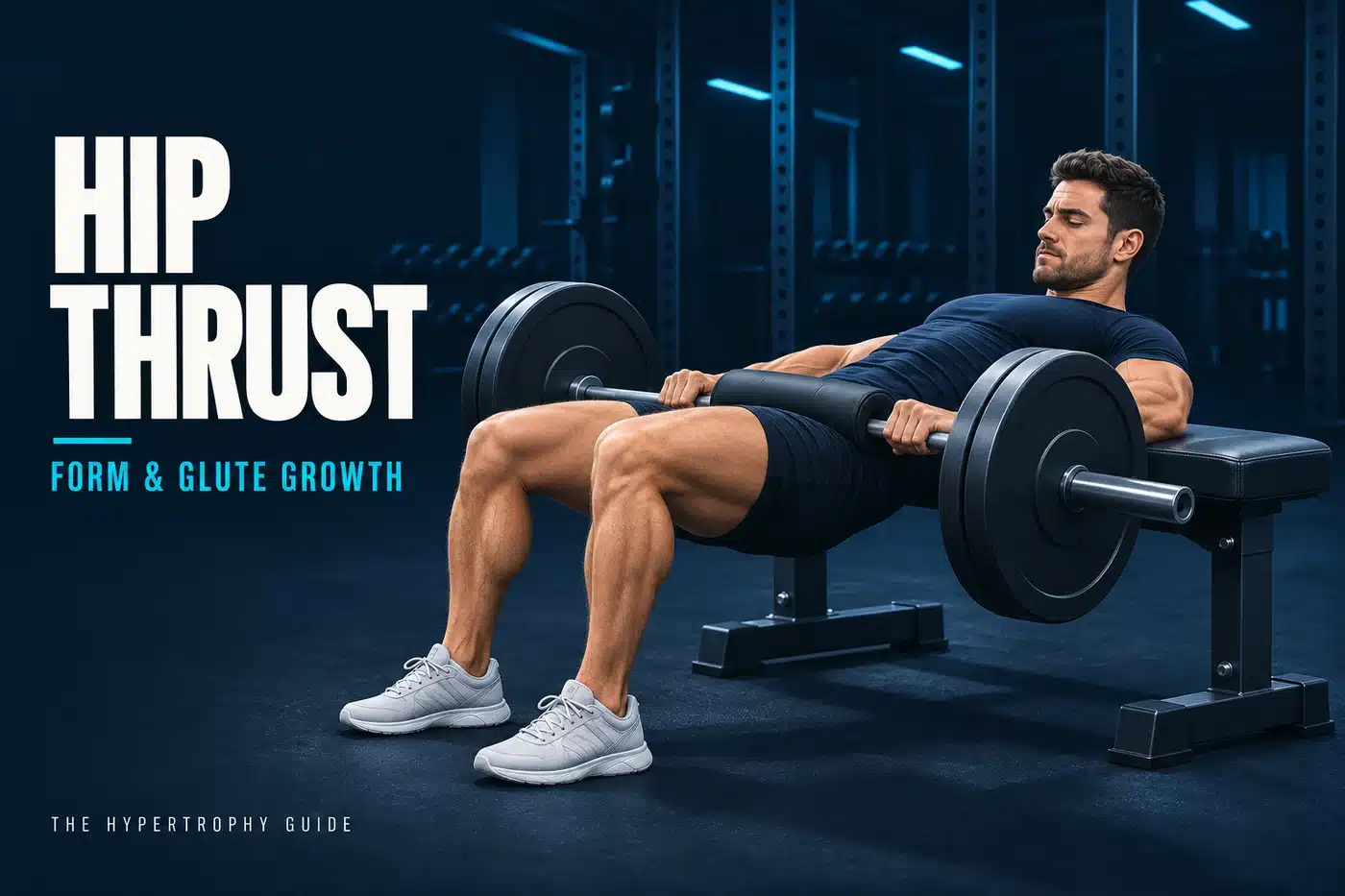
The hip thrust is a hip-extension exercise you can use to add focused glute work to your programme. Support your upper back, keep your feet planted and lift your hips without chasing extra height through your lower back. A barbell and a dedicated machine are both options; choose the setup you can use comfortably and repeat.
How to set up a barbell hip thrust
Practise the movement with a manageable load before adding hard sets. A large number on the bar is not useful if the bench moves, the bar hurts or you cannot repeat the movement.
- Secure your support. Use a bench that will not slide or tip. Set the edge around the lower part of your shoulder blades, rather than against your neck. Adjust the support if the height prevents a comfortable movement.
- Pad the bar. Place it across your hip crease with suitable padding. Hold it steady with your hands. Check comfort with a light load before adding plates.
- Find your foot position. Start around hip-to-shoulder width, with a comfortable toe angle. At the top, aim for roughly upright shins and about a right angle at the knees. Adjust from there rather than chasing an exact measurement.
- Set your gaze and brace. Keep your chin lightly down and look forward, over your abdomen or towards the pad. Create enough trunk tension to control the movement without forcing your neck down.
- Lift through your hips. Keep your feet planted and raise your pelvis into a controlled top position. Finish the hip movement without adding an exaggerated lower-back arch.
- Lower together. Let your upper body move with your hips around the bench support. Lower into a range you can control, then repeat without bouncing or losing your position.
What if you feel your hamstrings, lower back or bar pressure?
You do not need to feel only your glutes for a set to be useful. Sensation is a prompt to review the setup, not proof of which muscle will grow. Change one thing at a time so you can tell what helped.
| What happens? | What to check first |
|---|---|
| Your feet slide or heels lift | Reduce the load, check floor grip and move your feet a little closer or farther away. Recheck that your whole foot stays supported. |
| Your hamstrings dominate or cramp | Review foot position and load. Also consider what you trained beforehand: hamstring fatigue after Romanian deadlifts is not automatically a hip-thrust technique error. |
| You finish by arching your lower back | Use a lighter load and stop the upward movement before the arch takes over. Recheck your brace, gaze and lowering range. |
| The bar pressure limits the set | Improve the padding and bar placement. Any extra pad or folded towel must stay secure. A machine may offer a more comfortable alternative. |
| The lowering phase feels awkward | Practise slowly with less weight, letting the torso follow the hips rather than holding the chest fixed. |
Do not force painful reps or assume a cramp tells you exactly what is wrong. If discomfort persists despite changing the setup and load, stop the aggravating variation and get individual advice.
Barbell hip thrust or hip thrust machine?
Choose the version that lets you train consistently. Sylvia often prefers a dedicated hip thrust machine for clients because the setup and loading are easier to manage. Alex also values a setup where pressure and discomfort do not distract from the exercise.
| Variation | Practical consideration |
|---|---|
| Barbell hip thrust | You can adjust the bench, feet and padding, but must secure the equipment and position the bar yourself. |
| Hip thrust / glute drive machine | The support and loading system can simplify setup. Follow the machine’s instructions and adjust its pad or belt before loading. |
| Smith machine hip thrust | An option if the bar path, bench placement and available space allow a comfortable setup. Set the safeties appropriately. |
A machine with an angled footplate does not have to look exactly like a barbell hip thrust on a flat floor. Its geometry may change where your feet sit. Keep the useful principles—stable support, planted feet and controlled motion—without copying a floor-based knee angle rigidly.
How many sets and reps should you do?
Alex most often uses 2–3 sets of 8–12 reps with 1–3 reps in reserve (RIR). Once a client knows the exercise, two working sets are often his starting point. More focused glute training may justify a third set, depending on the rest of the week.
On a leg day, he usually places hip thrusts second or third, rather than first or right at the end. That is his practical preference, not a rule. The right place depends on which exercises you want to prioritise and how much fatigue you bring into them.
| Part of the session | What to do |
|---|---|
| Preparation | Use light practice and warm-up sets as needed. Keep these separate from your planned working sets. |
| Working sets | Start with 2 × 8–12, leaving around 1–3 clean reps available. |
| Optional third set | Consider it if glutes are a priority and the added work fits your recovery and weekly programme. |
| Progression | Build reps with the same controlled movement. Once both sets reach 12 within your intended RIR range, try a small load increase and work up again. |
For example, 12 and 9 reps at the same weight is a reason to keep building the second set—not automatically add weight because the first set reached 12. If you change the machine, support or range of motion, establish a new baseline before comparing loads.
Sylvia sometimes programmes hip thrusts twice weekly, with a moderate-rep session and a heavier session according to the client’s goal. You do not need that frequency or a 4–6-rep day to use the exercise for muscle growth.
Count hip thrusts alongside the glute work already coming from squats, split squats and hinges. Our leg-training guide helps you put those movements together. Use the training volume calculator to review the weekly workload, and the RIR guide if estimating effort is new to you.
Are hip thrusts necessary for glute growth?
No single exercise is compulsory. In a nine-week study of untrained participants, squat and barbell hip thrust training produced similar glute growth, while squats produced more thigh growth. Strength gains favoured the exercise practised. The hip thrust’s higher glute EMG readings did not establish greater growth. These findings describe one short study in novices, not every lifter or programme. Read Plotkin et al. (2023).
A 2025 systematic review also found that several resistance-training approaches can grow the gluteus maximus. The evidence includes varied methods and relatively small studies, so it supports having useful options rather than declaring one universal winner. Read Krause Neto et al. (2025).
Choose hip thrusts when they fit the glute work you want to add and the equipment you enjoy using. You can also build a programme around other movements without needing to squeeze them in.
Hip thrust questions
Do my knees have to be exactly 90 degrees?
No. Roughly upright shins at the top are a useful starting cue for a barbell setup. Your proportions, bench and machine design can change the position that works comfortably.
Should I squeeze higher at the top?
Finish a controlled hip extension, then lower again. Do not chase extra height by throwing your head back or exaggerating a lower-back arch.
Can I use a machine instead of a barbell?
Yes. Use its adjustments and instructions, and log the variation you actually use. Loads on different machines and barbells are not directly interchangeable.