Managing Fatigue in Hypertrophy Training
TL;DR
Managing fatigue in hypertrophy training is a key factor in determining how much muscle you can build, how long progress continues, and when plateaus begin to appear.
- Muscle growth depends on the balance between training stimulus and accumulated fatigue.
- Too little fatigue → insufficient stimulus.
- Too much fatigue → stalled progress or regression.
- Effective hypertrophy training manages both local (muscle) and systemic fatigue over time.
- Fatigue management is the framework that explains volume limits, deloads, and recovery needs.
What Is Fatigue in Hypertrophy Training?
In hypertrophy training, fatigue refers to the temporary reduction in performance caused by repeated training stress. It is not inherently bad — fatigue is necessary for adaptation — but it must be controlled.
Fatigue exists on a spectrum and accumulates across:
- Sets
- Sessions
- Training weeks
- Mesocycles
The key is not avoiding fatigue, but managing how much you accumulate and when.
Types of Fatigue That Matter for Muscle Growth
1. Local (Peripheral) Fatigue
This occurs within the trained muscle.
Includes:
- Metabolic byproduct accumulation
- Reduced force production
- Muscle damage
- Reduced calcium handling
Why it matters:
Local fatigue limits how many high-quality sets you can perform for a muscle. Excessive local fatigue reduces effective volume within a session.
2. Central (Systemic) Fatigue
This affects the nervous system and overall performance capacity.
Includes:
- Reduced motor drive
- Decreased coordination
- General heaviness or sluggishness
- Reduced motivation to train
Why it matters:
Systemic fatigue impacts multiple muscle groups and can degrade performance across sessions — even when individual muscles feel “recovered.”
3. Psychological Fatigue
Often overlooked, but highly relevant.
Includes:
- Mental burnout
- Reduced training motivation
- Increased perceived effort
- Loss of focus or enjoyment
Why it matters:
Hypertrophy requires long-term consistency. Psychological fatigue often appears before physical breakdown.
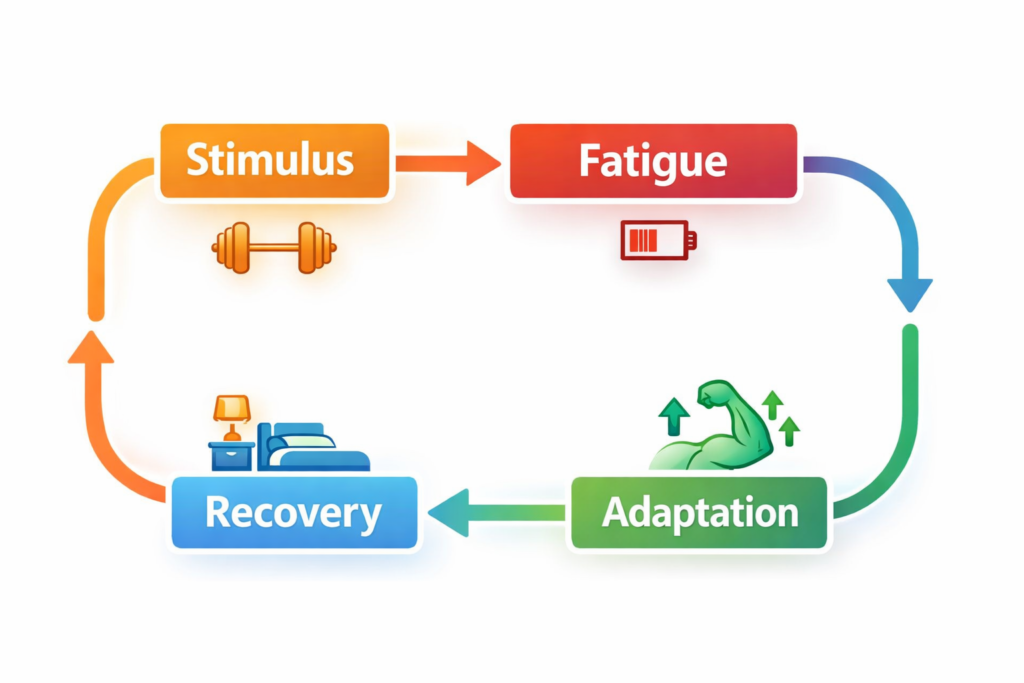
The Stimulus–Fatigue–Recovery Model
Hypertrophy can be understood as a repeating loop:
- Training stimulus creates fatigue
- Recovery processes dissipate fatigue
- Adaptation occurs after recovery
If fatigue exceeds recovery capacity:
- Performance drops
- Volume tolerance decreases
- Growth slows or stops
If stimulus is too low:
- Fatigue is minimal
- Adaptation is minimal
Optimal hypertrophy lives in the middle.
In practice, managing fatigue in hypertrophy training determines how long you can continue progressing before recovery becomes the limiting factor.
Why Fatigue Accumulates Over Time
Fatigue is additive, not reset session-to-session.
Contributors include:
- High weekly volume
- Training close to failure
- Short rest periods
- High frequency
- Poor sleep or caloric intake
- Psychological stress
This is why programs that work well for 2–4 weeks often stall at weeks 6–8 unless fatigue is managed deliberately.
This is why increases in training volume for hypertrophy should be gradual rather than aggressive, as excessive volume accelerates fatigue accumulation faster than recovery capacity can adapt.
Higher training frequency for muscle growth can be effective, but only when total volume and fatigue are managed appropriately across the week.
Signs Fatigue Is Becoming a Problem
Common indicators include:
- Declining strength despite consistent effort
- Reduced pump or mind-muscle connection
- Longer recovery times between sessions
- Joint or connective tissue irritation
- Persistent soreness
- Loss of motivation or dread before training
Importantly: fatigue often masks itself as “lack of discipline”, when the real issue is recovery debt.
Fatigue vs. Muscle Damage
Muscle damage is not required for hypertrophy and is a poor proxy for progress.
- Damage increases fatigue without necessarily increasing stimulus
- Excessive soreness reduces training quality
- Repeated-bout effect reduces damage over time anyway
Well-designed hypertrophy training prioritizes mechanical tension, not soreness accumulation.
Managing Fatigue Without Reducing Growth
Effective strategies include:
- Gradual volume progression instead of sudden jumps
- Strategic proximity to failure (not every set to failure)
- Adequate rest periods
- Planned deloads
- Appropriate exercise selection
- Matching volume to recovery capacity
Fatigue management is not about training less — it is about training more sustainably.
Why Fatigue Management Comes Before Deloads and Sleep
Deloads and sleep are tools, not frameworks.
You cannot decide:
- when to deload
- how to deload
- why recovery matters
…until fatigue itself is clearly understood.
This article forms the conceptual foundation for:
- Deload strategies
- Volume landmarks
- Recovery optimization
- Long-term progression planning
Practical Takeaways
- Fatigue is necessary — unmanaged fatigue is the problem
- Local and systemic fatigue affect hypertrophy differently
- Accumulated fatigue explains plateaus better than “bad genetics”
- Sustainable progress requires fatigue control across mesocycles
- Deloads and recovery strategies only make sense in this context
References
Schoenfeld BJ.
The mechanisms of muscle hypertrophy and their application to resistance training.
Journal of Strength and Conditioning Research. 2010.
https://pubmed.ncbi.nlm.nih.gov/20847704/
Grgic J, Schoenfeld BJ, Skrepnik M, Davies TB, Mikulic P.
Effects of resistance training performed to repetition failure or non-failure on muscular strength and hypertrophy: A systematic review and meta-analysis.
Journal of Sport and Health Science. 2021.
https://pmc.ncbi.nlm.nih.gov/articles/PMC9068575/
Vieira JG, Umpierre D, Teodoro JL, Lisboa SC, Baroni BM.
Effects of resistance training to muscle failure on acute fatigue: A systematic review and meta-analysis.
Sports Medicine. 2022.
https://pubmed.ncbi.nlm.nih.gov/34881412/
Bell L, Burnett A, McLean S, McGill S.
Overreaching and overtraining in strength sports and resistance training: A scoping review.
Sports Medicine. 2020.
https://pubmed.ncbi.nlm.nih.gov/32602418/
Grandou C, Wallace L, Impellizzeri FM, Allen NG, Coutts AJ.
Overtraining in resistance exercise: An exploratory systematic review and methodological appraisal of the literature.
Sports Medicine. 2020.
https://pubmed.ncbi.nlm.nih.gov/31820373/