What Does a Bodybuilder Eat in a Day?
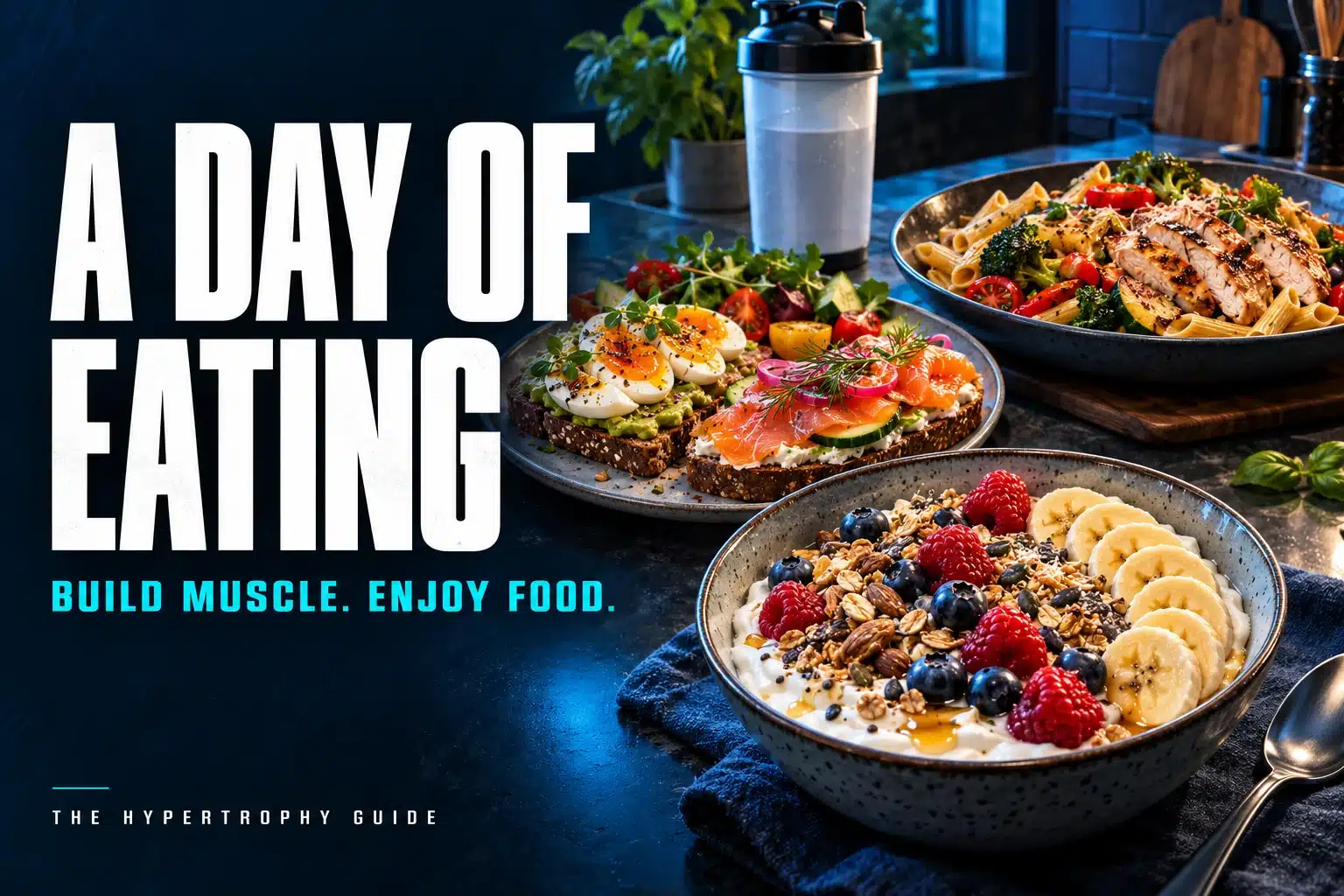
A bodybuilder’s day of eating can include ordinary meals: yogurt and oats, a chicken or tofu lunch, a snack around training, and dinner with protein, carbohydrates and vegetables. It does not have to mean six containers of plain chicken and broccoli.
Build meals around your daily energy needs, enough protein and a varied diet. Choose a meal schedule you can repeat. Three main meals with an optional snack can be practical; six smaller meals are another way to organize food, not a requirement for looking like a bodybuilder.
Below is a realistic example, a comparison of three versus six meals, and what I changed after years of treating food mainly as fuel. My current routine is recreational lifting with a focus on deadlift progress, not a contest-preparation diet.
A realistic day of eating for muscle-building training
This is an adaptable example based on how I eat now. Portions will change with body size, appetite, training and whether you want to gain, maintain or lose weight. It is not a calorie-counted meal plan.
| Meal | An example | Make it work for you |
|---|---|---|
| Breakfast | Skyr or Greek yogurt, muesli, berries and banana; some peanut butter if you enjoy it. | Choose the portion that suits your appetite. Oats can replace muesli. A suitable high-protein plant-based option is another choice. |
| Lunch | Whole-grain sandwiches with eggs, tuna, salmon, chicken or tofu, plus vegetables. | I often eat rye bread at work. Rice or potato leftovers can do the same practical job. |
| Optional afternoon snack | A banana and a protein shake, or another snack you tolerate well. | Useful when lunch was several hours ago and training is coming up. It does not have to be a shake. |
| Dinner | Pasta, rice or potatoes with a protein source and vegetables. A mixed dish such as lasagna also fits. | Use seasonings and sauces you enjoy. Portions and ingredients matter more than whether the meal looks like a bodybuilding meal. |
| Optional evening food | Yogurt, a shake or another snack if you are hungry or still need food. | Nuts can add useful energy and fats, but a handful is not a protein-equivalent replacement for a shake. |
If you want to estimate your own starting intake, use the macro calculator. For the protein target itself, see our protein guide. Those numbers are starting points to evaluate against your actual progress, not instructions to copy someone else’s meals.
How I used to eat: plenty of discipline, very little enjoyment
When I started following bodybuilding-style meal plans, breakfast might be an omelet with spinach. Then came a shake and a banana, chicken with rice and broccoli, another shake, and another similar dinner. Beef or potatoes felt like a major change.
I avoided dressing and often cooked chicken in the oven partly because I thought I should avoid cooking fat. Eventually I used low-calorie sauces because the food had become so dry and repetitive. I thought eating “clean” was almost the point of the diet.
The bigger cost was how much the rules occupied my head. I sometimes ate before social events and said I wasn’t hungry, or brought a prepared meal. Eating something outside the plan could make me feel guilty. Looking back, I wanted a way to train seriously without making food and social life so difficult.
That is my experience, not a claim that meal preparation or a structured plan is bad. Preparing food can make life easier. The useful question is whether the structure helps you eat and train consistently or makes ordinary life unnecessarily restrictive.
Do bodybuilders need six meals a day?
No fixed meal count is compulsory. A bodybuilding nutrition review describes three to six meals as a practical range, while sports-nutrition guidance emphasizes adequate daily protein and considers its distribution across the day.[1][2] This does not establish that any three-meal diet and any six-meal diet produce identical results.
| Consideration | Three larger meals | Six smaller meals |
|---|---|---|
| Daily routine | Fewer eating occasions to plan; often convenient with work or family meals. | More preparation and interruptions, but may suit people who prefer regular snacks. |
| Appetite | Larger portions may feel satisfying or uncomfortably big, depending on the person. | Smaller portions may be easier when total food intake is high; others find them less satisfying. |
| Protein | Each meal needs to contribute meaningfully to the daily total. | The total is divided into more portions. More occasions do not automatically mean more muscle. |
| Training | A snack may help if lunch and training are far apart. | One of the meals can fit around training without adding an extra feeding. |
| A useful compromise | Three main meals and one optional snack. Adjust to your needs instead of defending a particular meal count. | |
A simple arithmetic example: a hypothetical 150 g daily protein intake could be divided into three meals of 50 g or six meals of 25 g. Both add up to 150 g. That is an illustration of distribution, not a personal protein recommendation or proof of equal outcomes. Our protein-per-meal guide covers the detail.
What changed in my current routine?
Breakfast is often around 300–400 g of skyr, roughly 50 g of muesli, some banana or berries, and peanut butter or occasionally a little Nutella. Lunch is usually food available at work, often rye bread with a protein-based topping and plenty of vegetables.
I normally eat lunch around noon and train around 3:30–4 p.m. A banana and sometimes a shake fit that gap. If I remember to bring a shake, I may have it earlier in the afternoon rather than immediately before training.
At dinner, I eat ordinary varied meals: pasta, potatoes, lasagna, a protein source and vegetables. I no longer need every plate to look the same.
At the moment, I estimate that I get around 120–140 g of protein a day. I am not carefully tracking calories or carbohydrates, and I am not currently cutting. My main training interest is progressing my deadlift. That number describes my present habits; it is not the intake I prescribe to every reader.
I still care about training, but I feel happier when it occupies less of my life than it did during those rigid meal-plan periods.
Does food quality still matter if calories and protein are covered?
Yes. Calories and protein do not tell you everything about fiber, vitamins, minerals or the overall variety of your diet. Vegetables, fruit, whole grains, different protein sources and unsaturated fats all have a place. Harvard’s Healthy Eating Plate is a useful general framework for that variety, rather than a bodybuilding macro prescription.[3]
I would now spend less effort making food perfectly plain and more effort making the overall pattern enjoyable and varied. Enjoying sauce, white pasta or dessert does not mean the entire day’s eating has failed.
| If this happens | Try this practical change |
|---|---|
| You rarely remember fruit | Keep a familiar fruit with a meal you already eat, such as berries with yogurt or a banana with lunch. |
| Meal preparation becomes repetitive | Keep the basic protein and carbohydrate portions, then rotate vegetables, seasoning and sauces. |
| You rely on shakes for most protein | Use more ordinary meals where practical. Shakes can fill gaps without replacing all the variety of food. |
| A social meal feels like breaking the plan | Let that meal be part of your normal week. One plate does not have to determine how you judge your whole diet. |
What about the post-workout shake?
I used to think I needed protein within 30 minutes of finishing training. Now I consider when I last ate and when dinner will happen. If I am going straight home to eat, a separate shake may add little convenience. If dinner is still a couple of hours away or I have little appetite, a shake can be useful.
Research guidance does not support treating the first half-hour as a universal deadline. Daily intake matters, and the meal eaten before training affects how urgent the next feeding is.[2] See our protein timing guide if you want the full explanation.
Common questions
Do I have to eat chicken and rice?
No. They are convenient ingredients, not a required combination. Fish, eggs, dairy, legumes, tofu and other foods can contribute to a useful eating pattern. Choose combinations you enjoy and can prepare.
Can I build muscle while eating three meals a day?
Three meals can support a suitable total intake and regular protein servings. Whether your plan works also depends on your training, energy intake, portions and consistency. Add a snack if three meals make those needs difficult to cover.
Is this how a competitive bodybuilder eats before a show?
No. Contest preparation can involve much tighter control and different priorities. This article is about practical eating alongside muscle-building training and my own experience, not a stage-ready diet.
Set up meals you can repeat comfortably, then check whether your intake supports your goal.
References
- Iraki J, Fitschen P, Espinar S, Helms E. Nutrition Recommendations for Bodybuilders in the Off-Season: A Narrative Review. Sports. 2019.
- Kerksick CM, et al. International Society of Sports Nutrition position stand: nutrient timing. JISSN. 2017.
- Harvard T.H. Chan School of Public Health. Healthy Eating Plate. General dietary-pattern guidance.