
Protein for Muscle Growth: Intake, Sources & Timing
For many adults who lift weights, approximately 1.6–2.2 g of protein per kilogram of body weight per day is a practical starting range. Total daily intake matters more than perfect timing, and protein powder is useful only when it makes that target easier to reach.
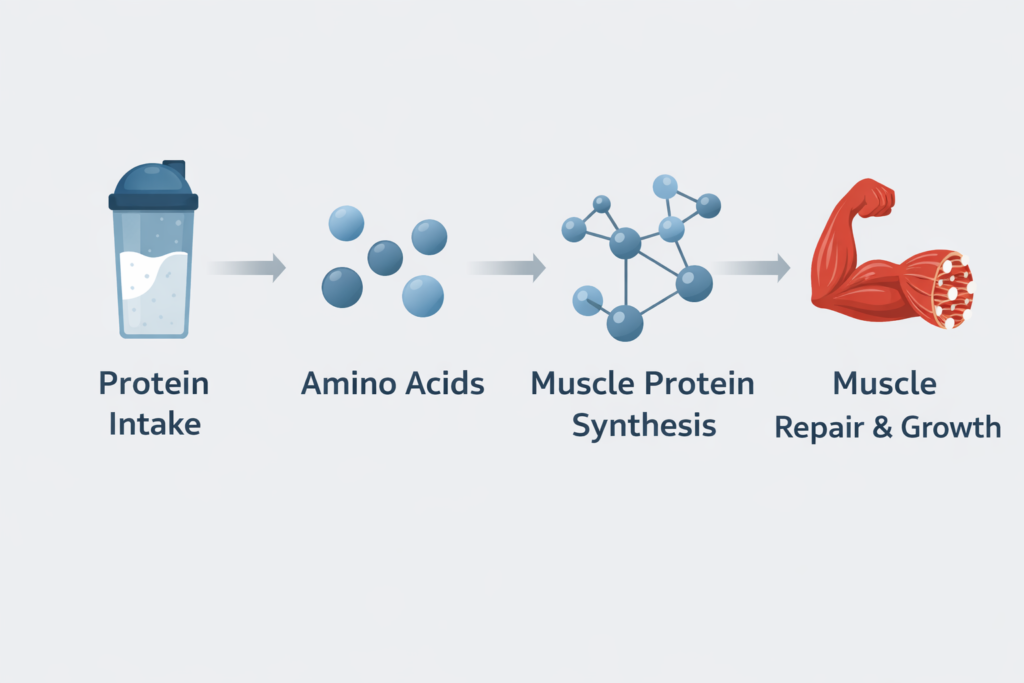
Why Protein Matters for Muscle Growth
Protein supplies amino acids that the body uses to build and repair tissue. Resistance training increases the demand for muscle remodelling, but protein does not create meaningful hypertrophy by itself. Training provides the stimulus; sufficient energy, protein and recovery allow adaptation.
Muscle mass can increase when muscle protein synthesis exceeds muscle protein breakdown over time. A single meal or workout does not determine the result. What matters is the repeated pattern across weeks and months.
How Much Protein Do You Need Per Day?
A practical target for many resistance-trained adults is approximately 1.6–2.2 g/kg/day. Meta-analytic evidence suggests average additional resistance-training benefits begin to level off around 1.6 g/kg/day, while the upper part of the range provides room for individual variation.1
This is a starting range, not a pass-or-fail threshold. Body weight, age, energy intake, food selection, leanness and training can all influence the most useful target.
| Body weight | 1.6 g/kg | 2.2 g/kg |
|---|---|---|
| 60 kg | 96 g/day | 132 g/day |
| 75 kg | 120 g/day | 165 g/day |
| 90 kg | 144 g/day | 198 g/day |
When might the upper end make sense?
- During a calorie deficit, particularly for lean and well-trained lifters
- When a higher-protein eating pattern improves fullness and adherence
- When plant proteins make up most of the diet and intake or quality needs more attention
More is not automatically better. Once an appropriate intake is covered, very high protein intake does not reliably create proportional gains in muscle. Use the daily protein guide for calculations and individual examples, or the THG Macro Calculator for a starting plan.
Best Protein Sources for Muscle Growth
Whole foods should normally provide most of your protein because they also contribute energy, micronutrients and dietary variety. No single food is mandatory.
Animal and plant proteins are not always interchangeable gram for gram. Digestibility, dose and amino acid composition can affect how efficiently a serving supplies essential amino acids. A well-planned plant-based diet can still support strength and muscle growth.4
See the dedicated guides to the best protein sources for muscle growth and animal versus plant protein.
Protein Quality, Leucine and Amino Acids
Nine amino acids are essential and must come from the diet. Leucine participates in the signalling that activates muscle protein synthesis, but there is no universal leucine threshold that guarantees a maximal response for every person and meal.
A serving containing roughly 20–40 g of high-quality protein often works well in practice. Larger people, older adults and lower-quality protein sources may benefit from the upper end or beyond. Scores such as DIAAS and PDCAAS describe protein quality, but daily intake, meal size and food variety matter more to most readers than chasing a perfect score.
Does Protein Timing Matter?
Timing matters less than total daily intake. You do not need to drink a shake the moment a workout ends. A protein-containing meal within a reasonable period before or after training is normally sufficient.
Distributing protein across three to five meals is a practical way to provide repeated servings during the day. That does not mean a meal containing more than 40 g is wasted; the body still digests and uses it.
Read whether protein timing matters and how much protein to eat per meal for the detailed versions.
Do You Need Protein Powder?
No. Protein powder is a convenient food product, not a requirement for hypertrophy. It becomes useful when work, appetite, budget or food preferences make an appropriate daily intake difficult.
A Whey Option THG Assessed
The card below documents one whey product available through THG’s current UK affiliate partner. It is not a claim that the product is necessary or universally superior to every suitable alternative.
For the full decision framework, read whether whey protein is worth taking for muscle growth.
Safety and Common Myths
Does high protein damage healthy kidneys?
In adults without chronic kidney disease, controlled trials and systematic reviews have generally not found evidence that higher-protein diets damage kidney function over the durations studied.5 Evidence at extreme intakes over many years is less complete. Anyone with kidney disease, reduced kidney function or a relevant medical concern should seek individual clinical guidance.
Is protein above 30–40 g in one meal wasted?
No. A larger serving may not increase muscle protein synthesis indefinitely, but the protein is still digested and used for other tissues and metabolic purposes. Daily intake and a sustainable meal pattern are the priority.
Is protein powder better than food?
Not inherently. Whey is convenient and rich in essential amino acids, while whole foods often provide greater variety and additional nutrients. Choose the option that solves the practical problem.
Practical Protein Plan
- Choose a starting target within approximately 1.6–2.2 g/kg/day.
- Build most meals around a meaningful protein source.
- Distribute intake across a meal pattern you can repeat.
- Adjust for preference, appetite, results and medical needs.
- Add protein powder only if it improves convenience or consistency.
Frequently Asked Questions
How much protein do you need per day to build muscle?
Approximately 1.6–2.2 g/kg/day is a practical starting range for many resistance-trained adults. Individual needs vary, so it should not be treated as a rigid threshold.
Is 2 g of protein per kilogram necessary?
Not necessarily. Average resistance-training benefits appear to show diminishing returns around 1.6 g/kg/day, while a higher target can provide a margin for individual variation.
Can plant protein build muscle?
Yes. Plant protein can support muscle growth when total intake and essential amino acids are adequate. Dose, digestibility and food selection still matter.
Is protein powder required?
No. It is a convenient way to help reach a protein target, but it offers no unique requirement when food already covers your needs.
References
- Morton RW et al. Protein supplementation and resistance-training adaptations: systematic review and meta-analysis. Br J Sports Med.
- Phillips SM, Van Loon LJC. Dietary protein for athletes: from requirements to optimum adaptation. J Sports Sci.
- Schoenfeld BJ, Aragon AA. How much protein can the body use in a single meal for muscle-building? J Int Soc Sports Nutr.
- Lim MT et al. Animal versus plant protein in supporting lean mass and muscle strength. Nutrients.
- Devries MC et al. Kidney function with higher- versus lower-protein diets in healthy adults. J Nutr.


