Vitamin B12 for Vegans: Sources, Supplements & Doses
Plant-based?
Give B12 a clear place.
Vitamin B12 for vegans deserves deliberate planning. Fortified foods and supplements are the reliable options; a varied diet of unfortified plant foods does not settle the question. Vegetarians should also check their sources.[1], [2]
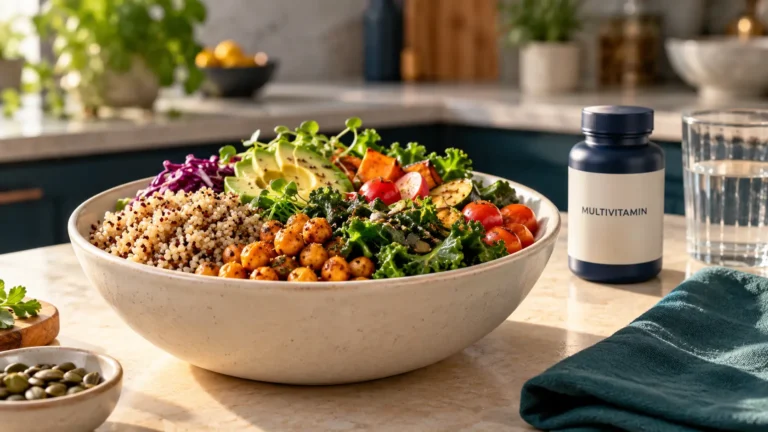
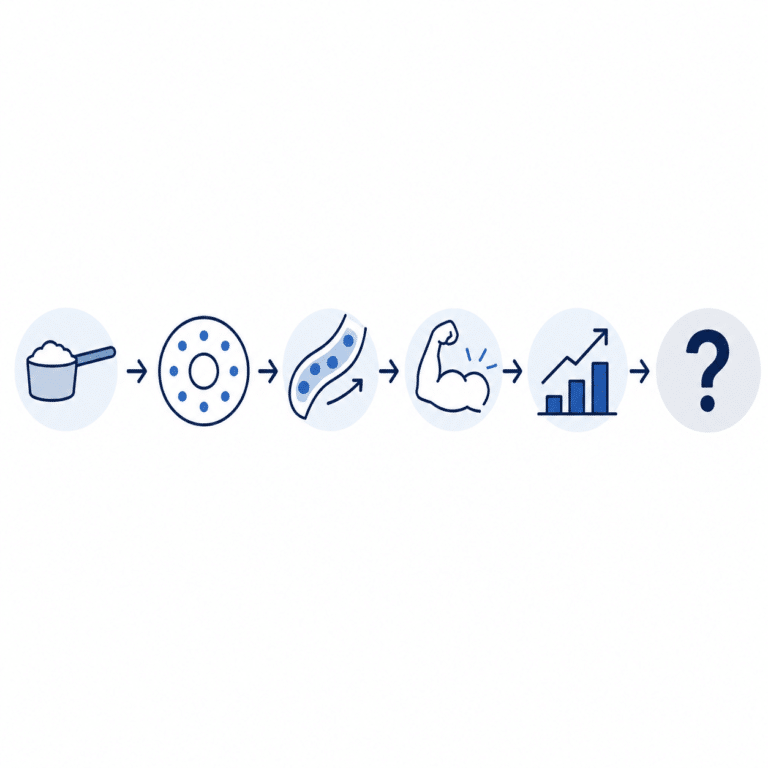
Getting enough protein and getting enough B12 are different jobs. A plant-based meal can fit your protein target while your overall routine still lacks a dependable B12 source. Treat this as a practical nutrition check, alongside the training plan, rather than another item in a muscle-building stack.
Do vegans and vegetarians need B12 supplements?
Vegan diet
Build in B12-fortified foods or a suitable supplement. Do not assume that “whole food,” “organic” or “plant-based” means a product supplies B12.[2]
Vegetarian diet
Eggs and dairy can contribute, but eating them occasionally does not prove adequate intake. Check the foods and amounts you regularly consume.[1]
A supplement can be the simpler route if fortified foods are inconsistent. If you already take B12, first check what the existing product provides and how often you take it. If you take a multivitamin, inspect its B12 content rather than adding a second product automatically.
Which vegan foods contain reliable B12?
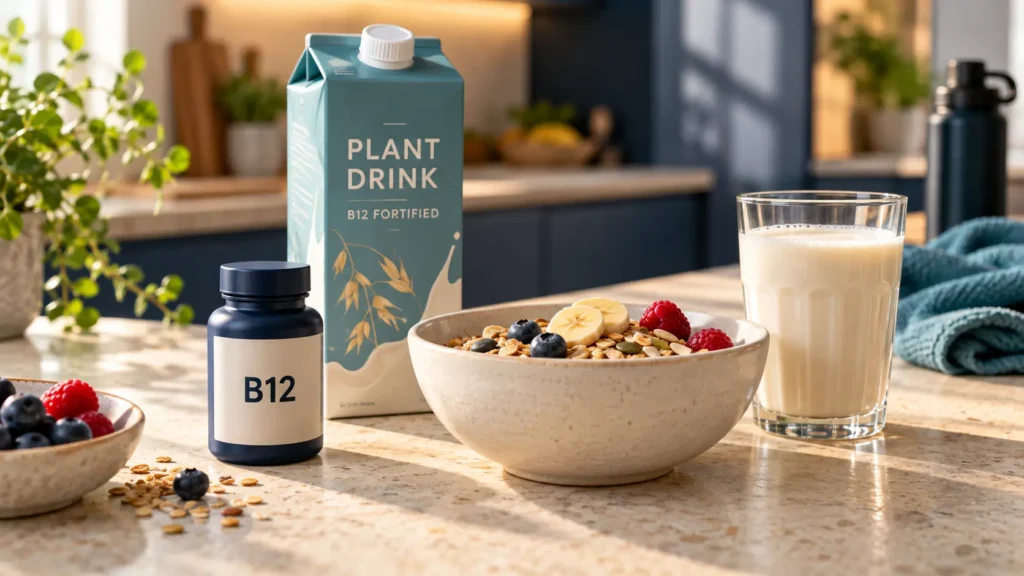
Look for added B12 in plant drinks, breakfast cereals and nutritional yeast. Fortification varies between products, so the food category alone is not enough.[2]
| Product | What to check | Easy mistake |
|---|---|---|
| Plant drink | B12 amount per 100 ml or serving, then your usual portion. | Assuming every carton is fortified. |
| Breakfast cereal | The nutrition label and the portion you normally eat. | Using the label’s serving when yours is much smaller. |
| Nutritional yeast | Whether B12 has been added. | Treating all nutritional yeast as equivalent. |
| Multivitamin | B12 per recommended serving and your actual frequency. | Reading “contains B vitamins” as a complete B12 plan. |
Fermented foods, seaweed and spirulina should not replace an established B12 source. For routine planning, choose an option with a declared amount rather than relying on an uncertain natural content.[3]
🏷️ A fictional carton, decoded
If a plant drink lists 0.4 micrograms per 100 ml, a 250 ml glass provides 1 microgram. That calculation tells you what the glass contributes. It does not, by itself, establish that your full routine meets your needs.
Use the label on your own carton. “One glass of plant milk” is not a fixed B12 dose.
How much B12 should a vegan take?
Food-based daily requirements and occasional supplement doses are not interchangeable: absorption varies with dose and frequency. As one established approach, The Vegan Society lists these alternative maintenance strategies:[3]
| Approach | Published guidance |
|---|---|
| Fortified foods | At least 3 micrograms daily, spread across two or three occasions. |
| Daily supplement | At least 10 micrograms daily. |
| Weekly supplement | At least 2,000 micrograms once weekly. |
These are attributed general maintenance options, not a prescription or a treatment plan for deficiency. Follow local guidance and product instructions. Children, pregnancy, breastfeeding, absorption problems and diagnosed deficiency need advice appropriate to the situation.
Choose a schedule that you can follow consistently. A weekly routine is only convenient if you remember it; a daily routine may fit better beside breakfast. Do not multiply a maintenance schedule because a workout was hard or you missed a personal best.
Cyanocobalamin or methylcobalamin?
The Vegan Society recommends cyanocobalamin as a stable, economical and well-researched choice. NIH guidance does not establish that a more expensive supplemental form produces better results. A premium-sounding name is not a reason to abandon a suitable existing product.[2], [1]
Does B12 improve energy or muscle growth?
B12 is needed for normal nerve function, red blood cell formation and DNA synthesis. That biological importance does not make extra B12 an energy or performance booster when your status is already sufficient.[1]
For a lifter, the useful distinction is whether you are meeting a nutritional need. A B12 plan does not replace enough food, an appropriate protein intake or progressive training. Our animal versus plant protein guide covers the protein question separately.
When should you get checked?
Persistent unexplained tiredness, tingling, numbness, balance changes or memory problems deserve medical assessment. They can have several causes. Do not use a supplement quiz to diagnose B12 deficiency or wait for symptoms to become severe.[4]
Assessment combines your history, symptoms and blood tests. It can also investigate why levels are low, including absorption difficulties. An ordinary maintenance plan is not a substitute for treatment, and B12 deficiency is not limited to people eating plant-based diets.[5]
Bring something useful to the conversation: the names or photos of your supplement labels, how often you use them, and your usual fortified foods. “I take a vitamin sometimes” is harder to assess than a clear routine.
Your three-point B12 check
- Source: identify the actual fortified foods or supplement.
- Amount: read the label in micrograms and check serving size.
- Routine: match the amount and frequency to appropriate guidance.
Quick questions
Can a multivitamin cover B12?
Possibly. Check its B12 amount, the recommended serving and how consistently you take it. Our multivitamin guide explains when a broad product may help and when a targeted option is clearer.
Should I take B12 before or after training?
Build the routine around consistency and the product’s instructions. B12 is not a pre-workout strategy, and a hard session is not a reason for an extra dose.
I feel fine. Can I ignore B12?
No. Feeling well does not tell you whether your intake is adequate. Make the source-and-label check part of planning a plant-based diet.
Sources and guidance
Educational nutrition guidance, not a diagnosis or treatment plan. How THG assesses supplements.
- NIH Office of Dietary Supplements. Vitamin B12: consumer fact sheet. Food sources, supplement forms and performance claims.
- The Vegan Society. Vitamin B12 guidance. Reliable sources and cyanocobalamin.
- The Vegan Society. B12 maintenance approaches for vegans. Fortified foods and supplementation schedules.
- NHS. B12 and folate deficiency symptoms.
- NHS. How B12 and folate deficiency are assessed.