Reps in Reserve (RIR): How Close to Failure?
A set can feel brutally hard and still end several repetitions before failure. That gap between how difficult a set feels and how close it actually is to failure is why reps in reserve (RIR) is useful—and why it is surprisingly difficult to judge well.
RIR gives that gap a number: how many more repetitions you could have completed with acceptable technique. Used well, it helps balance productive effort against fatigue. Used badly, it can turn a comfortable set into “2 RIR” simply because the lifter wanted it to end.
The practical question is not whether failure is good or bad. It is how close you need to get for hypertrophy, how accurately you can judge that distance, and when the extra fatigue of 0 RIR is worth paying for.
That is where training intensity for hypertrophy becomes more than the weight on the bar: it also describes how close the set comes to failure.
TL;DR
- RIR estimates how close a set is to muscular failure.
- 0 RIR means no additional repetitions could have been completed with acceptable technique; training to failure usually involves attempting another repetition and being unable to complete it.
- Hypertrophy occurs across a range of effort levels.
- Training to failure is not required for muscle growth.
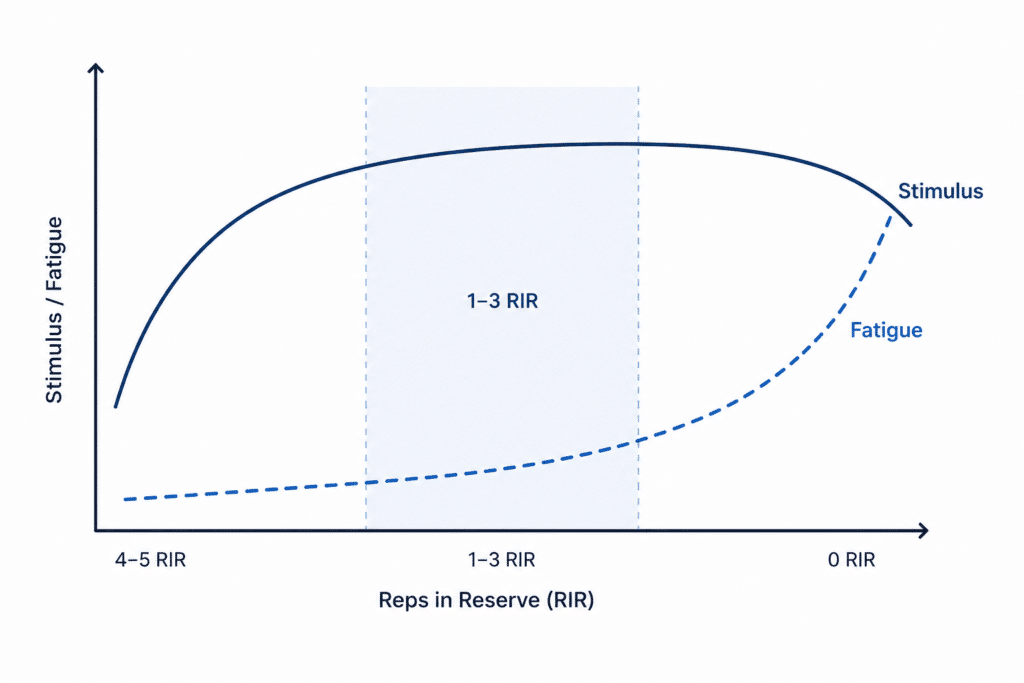
- For many lifters, 1–3 RIR is a useful practical default that balances a high per-set stimulus with manageable fatigue. It should not be treated as a universal optimal range.
- Fatigue and subsequent performance costs generally increase as sets are taken closer to failure.
- Most people need practice—and occasional safe failure tests—to calibrate their estimates.
Watch: How to Find Your Optimal Training Volume
Prefer to watch? This video walks you through five practical questions for finding your optimal training volume—including how proximity to failure affects what counts as a productive set, recovery, and whether you should add or reduce volume.
What Does RIR Actually Mean?
Reps in reserve (RIR) is a method used to estimate how many repetitions you could still perform at the end of a set before reaching muscular failure.
- 0 RIR → no additional repetitions could have been completed with acceptable technique
- 1 RIR → one repetition left
- 2–3 RIR → near failure
This concept allows you to standardize effort across exercises and sessions, making training more consistent and easier to adjust over time.
The definition matters: the repetitions left must still meet an acceptable technical standard. A final repetition may slow down and technique may become less tidy without the set automatically ending, but a repetition that only succeeds by changing the exercise is not a clean rep “in the bank.”
For hypertrophy, effort affects how much stimulus each set produces. However, effort also increases fatigue—especially as sets approach failure.
As a set approaches failure, more high-threshold motor units are likely to be recruited and their muscle fibres exposed to greater fatigue. This is sometimes described using the practical—but simplified—concept of effective reps.
This is why hypertrophy is not simply about training as hard as possible, but about accumulating sufficient stimulus while staying within recoverable limits.
This is closely related to how volume and intensity interact to determine total hypertrophy stimulus.
What the Evidence Suggests
Research shows that hypertrophy can occur across a wide range of effort levels, provided that sets are taken sufficiently close to failure.
Sets performed farther from failure generally provide less hypertrophic stimulus per set, particularly when lighter loads are used, although they can still contribute to muscle growth. However, once effort reaches a moderate-to-high level, additional proximity to failure appears to provide diminishing returns relative to fatigue.
This suggests that:
- Training to absolute failure is not required for hypertrophy.
- Near-failure training produces most of the growth stimulus.
- Training to failure generally produces more acute fatigue, performance loss and muscle damage than stopping with repetitions in reserve.
In practical terms, this means that consistently training to failure is often unnecessary and can limit overall training quality.
Why Most People Misjudge RIR
When I introduced RIR to clients, I described it as “good repetitions left in the bank.” I usually waited until a client had enough experience to recognise their own technique and effort before asking them to use the scale seriously.
I would occasionally ask a client after a set how many repetitions they believed they had left. A common answer after 12 repetitions was “maybe two or three.” In a later set, when I encouraged the same client to continue until they genuinely had nothing left, they could sometimes reach around 18 repetitions.
That was not a laboratory-grade measurement of the first set’s true RIR: fatigue, set order and performance can change between sets. But it repeatedly exposed the same practical problem. What felt close to failure was often just the point where the set became uncomfortable.
RIR estimates improve with experience, but they never become perfectly objective. Poor sleep, low motivation, stress and inadequate recovery can all make a set feel harder than usual. I still have days when a planned 2 RIR set probably ends closer to 4 RIR. The feeling is real; the estimate is simply biased by the day.
Use Rep Speed as a Clue, Not a Stopwatch
From the outside, concentric rep speed is one of the most useful clues. In exercises such as the bench press or leg press, a sudden and meaningful slowdown often shows that the lifter is entering the final few possible repetitions. If the weight continues moving at roughly the same speed, the set is usually not close to failure. A slight slowdown may still leave several repetitions; a grinding repetition that takes five seconds or more to complete may indicate 0–1 RIR.
This is not a universal conversion table. Exercise mechanics, intent, load and the individual lifter all change what rep speed looks like. It becomes useful when a coach or training partner has watched that person repeatedly—and ideally seen what their real failure looks like on the same exercise.
Why 0 RIR Is Not the Default
Training to failure has both benefits and costs.
Benefits:
- Ensures high effort.
- May maximize the hypertrophic stimulus obtained from an individual set.
Costs:
- Higher fatigue.
- Reduced performance in subsequent sets.
- Lower total recoverable volume.
Because fatigue increases as you approach failure, consistently training at 0 RIR can reduce how much total volume you can recover from.
This directly affects your optimal training volume and how much effective stimulus you can accumulate across a week.
Training too close to failure too often may also affect your minimum effective volume needs and increase overall fatigue accumulation.
For this reason, most hypertrophy programs rely primarily on near-failure training rather than constant failure training.
How I Program RIR in Practice
For most lifters, the majority of hypertrophy training should be performed within:
- 1–3 RIR
This range provides a strong balance between stimulus and fatigue.
These are starting points rather than rules:
- Compound exercises: often around 2–3 RIR
- Stable isolation exercises: often around 0–2 RIR
- Training to failure: used occasionally, not constantly
The goal is not to avoid failure entirely, but to use it strategically rather than as the default approach.
Over time, managing effort allows you to sustain performance and accumulate more productive training volume.
In a hypertrophy-focused training block, I have had good results starting the first week with relatively comfortable RIR targets, particularly on compound exercises, and gradually increasing effort across the following weeks. By roughly week five or six, some sets may reach 0–1 RIR. For strength-focused training, I use failure much less often because a failed heavy compound rep carries a higher technical and fatigue cost.
Isolation exercises are different. Taking a lateral raise, curl or machine exercise to 0–1 RIR is usually easier to manage than repeatedly grinding squats or bench presses. Exercise stability, technique and training experience should decide how aggressively the target is applied.
The Opposite Error: Training Too Hard
Some lifters have the opposite problem. I have coached “all or nothing” personalities who only considered a workout successful if every set reached failure. I sometimes had to say “stop” during a set because they would otherwise continue regardless of technique or the rest of the programme.
Several developed overuse problems when training alone and repeatedly returned to failure on everything. It is possible that their high effort produced a strong hypertrophy stimulus per set. The more useful question is whether they would have made better long-term progress with fewer injuries, fewer setbacks and more consistent performance.
The Practical Takeaway
If you train too far from failure, you may not generate enough stimulus for hypertrophy.
If you train to failure too often, fatigue may limit your total training volume and reduce overall progress.
Understanding how close to failure you should train allows you to:
- Balance stimulus and fatigue.
- Maintain performance across sessions.
- Accumulate more effective training volume.
- Progress more consistently over time.
For most hypertrophy lifters, 1–3 RIR is a useful default. But the number only helps if it is reasonably honest. Occasionally testing real failure on a safe, stable exercise can calibrate what the final repetitions actually feel like. An experienced coach or training partner can be even more valuable—especially on the days when your own perception is least reliable.
FAQ
Should you train to failure for hypertrophy?
Training to failure is not required for hypertrophy. For many lifters, 1–3 RIR is a useful practical default that provides a high per-set stimulus while keeping fatigue manageable.
What is the best RIR for muscle growth?
For many lifters, 1–3 RIR is a useful practical default that balances a high per-set stimulus with manageable fatigue. It should not be treated as a universal optimal range.
Is 0 RIR better than 1–2 RIR?
Training at 0 RIR is not consistently shown to produce meaningfully greater hypertrophy than stopping slightly short of failure. Using 1–2 RIR may therefore provide a similar stimulus in many contexts while reducing fatigue and preserving performance in subsequent sets.
Do beginners need to train to failure?
No. Beginners can achieve significant hypertrophy without training to failure. Focusing on technique and consistency at moderate effort levels is usually more effective.
Can you build muscle training far from failure?
Yes. Sets performed farther from failure generally provide less hypertrophic stimulus per set, particularly when lighter loads are used, although they can still contribute to muscle growth.