Effective Reps and Muscle Growth: What Really Stimulates Hypertrophy?
TL;DR
- Effective reps refer to the last repetitions performed close to muscular failure, where mechanical tension is highest.
- Muscle growth is primarily stimulated when high-threshold motor units are recruited due to accumulated fatigue.
- Similar hypertrophy can be achieved across a wide range of loads if sets are taken close enough to failure.
- Training to absolute failure is not required; most hypertrophy can be achieved within 0–3 reps in reserve.
- Effective reps help explain why effort matters, but they do not replace volume, progression, or structured programming.
What Are Effective Reps?
In the context of hypertrophy training, effective reps for hypertrophy describe the repetitions performed closest to muscular failure, where mechanical tension and muscle fiber recruitment are highest.
The idea behind effective reps is that not all repetitions stimulate muscle growth equally.
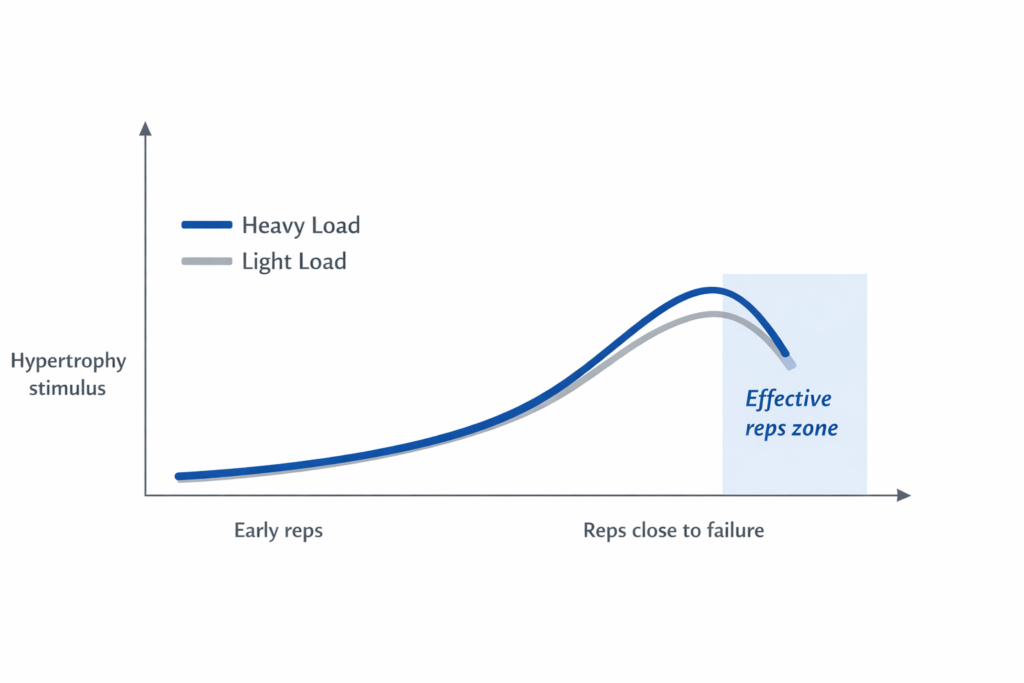
Early reps in a set are typically performed with low fatigue and limited motor unit recruitment. As fatigue accumulates, the nervous system is forced to recruit higher-threshold motor units, including fast-twitch muscle fibers with the greatest growth potential.
The repetitions performed closest to failure are therefore considered the most hypertrophy-relevant.
Why Proximity to Failure Matters
Muscle hypertrophy is driven primarily by mechanical tension at the muscle fiber level — which is a key part of what causes muscle growth in practice.
As a set approaches failure, fatigue increases, more motor units are recruited, and each active muscle fiber experiences higher relative tension. This is also influenced by the mind-muscle connection, which may affect how effectively you recruit the target muscle during a set.
Training too far from failure often fails to recruit high-threshold motor units, particularly when lighter loads are used. As a result, the hypertrophy stimulus may be reduced even if total volume appears sufficient.
Are Only the Last Reps Doing the Work?
Not exactly.
While the final repetitions of a set may contribute more stimulus per repetition, earlier reps still play a crucial role. They accumulate fatigue, gradually increase motor unit recruitment, and make it possible for the most effective reps to occur.
Effective reps should therefore be understood as the outcome of the entire set, not as isolated repetitions that function independently.
This also explains why effective reps cannot be viewed in isolation. Muscle growth depends not only on effort per set, but on how much total work is accumulated over time, which is discussed in more detail in our article on training volume for muscle growth.
Load, Rep Range, and Effective Reps
Research consistently shows that similar hypertrophy can be achieved across a wide range of loads, roughly between 30 and 85 percent of one-repetition maximum, as long as sets are taken sufficiently close to failure.
With heavier loads, fewer total repetitions are performed, but most reps are already mechanically demanding and close to being effective. With lighter loads, many repetitions produce relatively low stimulus early in the set, while effective reps are concentrated near the end as fatigue accumulates.
This explains why both low-rep and high-rep training can build muscle, provided effort is high enough.
This also highlights why training intensity for hypertrophy should be viewed as a combination of load and effort rather than load alone.
How Close to Failure Do You Need to Train?
The exact degree of effort required depends on load, exercise selection, and overall volume, which is explored further in our detailed guide on training close to failure for hypertrophy.
For hypertrophy, most evidence supports training within approximately zero to three reps in reserve (RIR).
Training at zero to one rep in reserve maximizes the number of effective reps but also increases fatigue. Training with two to three reps in reserve still appears to be effective for most exercises while allowing better recovery. Training further away from failure is more likely to reduce hypertrophy stimulus, especially when lighter loads are used.
Importantly, this does not mean that every set must reach failure. The key is that each working set should contain several effective reps.
Common Misinterpretations of Effective Reps
A common misconception is that only the last three repetitions matter. This is an oversimplification. While the final reps may contribute most, they rely on the earlier reps to make them possible.
Another misunderstanding is that effective reps require training to absolute failure. In reality, training close to failure is sufficient.
Finally, light weights are sometimes viewed as inferior. In practice, they can be just as effective for hypertrophy, as long as enough repetitions are performed to reach high fatigue levels.
How Effective Reps Fit Into Programming
Effective reps are best viewed as a conceptual tool rather than a rigid training rule.
They help explain why effort matters, why proximity to failure is important, and why very easy sets are unlikely to produce meaningful hypertrophy. However, they do not replace optimal volume management, intelligent programming, or progressive overload over time.
Over time, maintaining an effective hypertrophy stimulus requires gradual increases in training demands, which is why effective reps must be paired with progressive overload rather than treated as a static training principle.
Used correctly, the concept of effective reps can improve decision-making without oversimplifying the complexity of muscle growth.
Practical Takeaways
- Aim to perform most hypertrophy sets within 0–3 reps of failure to ensure sufficient effective reps.
- Both heavy and light loads can build muscle, but lighter weights require more total reps to reach effective reps near failure.
- You do not need to train to failure on every set; near-failure effort is sufficient for most exercises.
- Early reps in a set are not wasted — they accumulate fatigue and enable effective reps later in the set.
- Use the concept of effective reps to guide set effort, not as a replacement for volume, progression, or program structure.
FAQ
Do effective reps require training to failure?
No. Most hypertrophy can be achieved without reaching absolute failure. Training within approximately 0–3 reps in reserve appears sufficient to accumulate a high number of effective reps.
Can light weights produce effective reps?
Yes. Light weights can produce effective reps if sets are taken sufficiently close to failure, allowing high-threshold motor units to be recruited.
References
- Schoenfeld, B. J. (2010).
The mechanisms of muscle hypertrophy and their application to resistance training.
Journal of Strength and Conditioning Research.
https://pubmed.ncbi.nlm.nih.gov/20847704/ - Morton, R. W., et al. (2016).
Neither load nor systemic hormones determine resistance training–mediated hypertrophy or strength gains.
Journal of Applied Physiology.
https://pubmed.ncbi.nlm.nih.gov/27174923/ - Schoenfeld, B. J., Grgic, J., Ogborn, D., & Krieger, J. W. (2017).
Strength and hypertrophy adaptations between low- vs. high-load resistance training: A systematic review and meta-analysis.
Journal of Strength and Conditioning Research.
https://pubmed.ncbi.nlm.nih.gov/28834797/ - Grgic, J., Schoenfeld, B. J., Orazem, J., & Sabol, F. (2021).
Effects of resistance training performed to repetition failure or non-failure on muscular hypertrophy: A systematic review and meta-analysis.
Journal of Sport and Health Science.
https://pubmed.ncbi.nlm.nih.gov/33497853/