Lat Pulldown for Muscle Growth: Grip, Technique & Programming
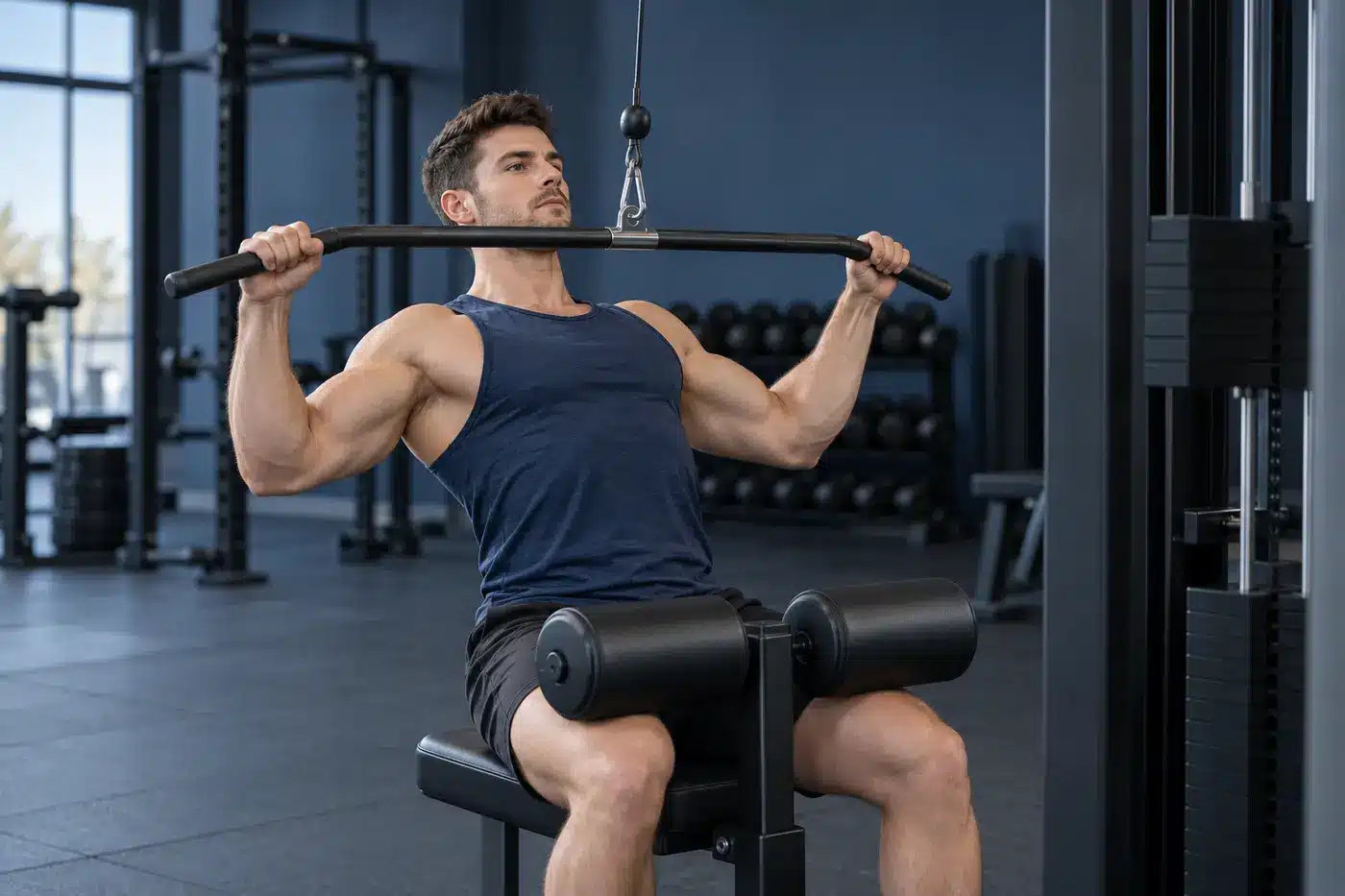
The lat pulldown is a scalable vertical-pulling exercise for training the latissimus dorsi and upper back. A medium-width pronated or neutral grip is a practical default, but current evidence does not support a single magical grip for building wider lats.
What Muscles Does the Lat Pulldown Work?
The latissimus dorsi is the main target. It extends and adducts the upper arm, which is why pulling the elbows down toward the torso is a useful description of the movement. The teres major assists, while the biceps, brachialis and brachioradialis flex the elbow. Muscles around the shoulder blades and upper back contribute to control and position.
The lat pulldown is not a complete back programme by itself. A horizontal row can add more work for the mid-back and rear shoulder, while hip-hinge work trains the spinal erectors differently. Select exercises according to the full programme rather than asking one movement to do everything; see the guide to exercise selection for hypertrophy.
What Is the Best Grip?
For most lifters, a grip near shoulder width or modestly wider is a reliable starting point. Pronated, neutral and supinated grips all train the back, but they change wrist comfort, elbow position and how much load can be used.
| Grip | Practical characteristics | Who may prefer it |
|---|---|---|
| Medium pronated | Traditional setup with balanced range and loading | Useful default for most lifters |
| Neutral | Palms face each other; often comfortable for wrists and shoulders | Lifters who dislike a straight bar |
| Supinated | More elbow flexion and often more biceps contribution | Those who find it comfortable and can control the bottom |
| Very wide pronated | Shorter range and often less load | Optional preference, not required for wider lats |
Acute research has found some differences in muscle activity between forearm orientations, while other comparisons report no meaningful activation differences across multiple pulldown variations. Grip width itself has generally produced smaller differences than gym folklore suggests. These studies measure immediate muscle activity, not long-term growth, so grip should be chosen primarily for comfort, control and progression.1, 2, 3
Does a wide grip build wider lats?
No evidence shows that an extremely wide grip uniquely widens the lats. It can shorten the range of motion and reduce the load you can control. A medium grip already trains shoulder adduction and extension effectively.
How to Perform a Lat Pulldown
- Adjust the thigh pad. It should hold you securely without forcing an uncomfortable hip position.
- Take a comfortable grip. Begin around shoulder width to moderately wider, or use a neutral attachment.
- Start tall with the arms overhead. Allow a controlled stretch while keeping the torso organised. The shoulders may elevate naturally; they do not need to stay pinned down.
- Use a small torso lean. A slight lean creates space for the bar. Keep it stable instead of repeatedly rocking backward.
- Drive the elbows down. Pull the bar or handles toward the upper chest or collarbone region. Think about moving the upper arms rather than merely curling the weight.
- Return with control. Let the elbows travel overhead until the lats are lengthened, then begin the next rep without bouncing the stack.
Should you pull to the chest or behind the neck?
Pulling in front toward the upper chest is the sensible default. Behind-the-neck pulldowns require more shoulder external rotation and do not offer a demonstrated hypertrophy advantage. They are not automatically injurious for every person, but there is little reason to force the position when a comfortable front pulldown is available.
Should you retract and depress the shoulder blades first?
The shoulder blades should move as part of the repetition. An exaggerated “down and back” hold can reduce the natural overhead position and turn the exercise into a short-range pull. Instead, control the shoulder girdle while allowing appropriate upward rotation and elevation at the top.
Lat Pulldown vs Pull-Up
| Factor | Lat pulldown | Pull-up |
|---|---|---|
| Load adjustment | Easy to change in small increments | Bodyweight sets the starting challenge |
| Beginner access | Highly scalable | May require assistance |
| Stability demand | Seated and externally stabilised | More whole-body control |
| Hypertrophy potential | High when progressively trained | High when progressively trained |
Neither is mandatory. The pulldown is often easier to dose precisely, while pull-ups are convenient and develop bodyweight pulling strength. Use the one you can perform through a repeatable range and progressively overload.
Sets, Reps and Progression
| Use | Sets × reps | Effort | Rest |
|---|---|---|---|
| Main vertical pull | 3–4 × 6–10 | 1–3 RIR | 2–3 min |
| Moderate-rep hypertrophy | 2–4 × 8–15 | 1–3 RIR | 90–180 sec |
| Technique practice | 2–3 × 10–15 | 3–4 RIR | 90–150 sec |
Use double progression: add reps within a selected range, then increase the stack when all sets reach the top with the same technique and target RIR. If the next plate jump is large, build extra repetitions first or use a small add-on weight.
One to three weekly exposures can work depending on the rest of your back training. In a full-body programme, the pulldown may rotate with rows or pull-ups. Count hard vertical and horizontal pulling sets when reviewing weekly volume.
Should you use lifting straps?
Straps are reasonable when grip consistently ends the set before the back. They do not remove the biceps from the exercise, and they are not necessary if grip is not limiting. You can train grip separately if it is also a goal.
Common Lat Pulldown Mistakes
Frequently Asked Questions
Which lat pulldown grip is best for muscle growth?
A comfortable medium pronated or neutral grip is a strong default. There is no proven universally superior grip, so use the one you can control and progressively load.
Should the bar touch my chest?
It may lightly reach the upper chest, but contact is not mandatory. Do not add excessive torso movement merely to force the bar lower.
Why do I feel pulldowns in my biceps?
The biceps assist every pulldown. Use a controlled elbow-driven motion, consider straps if grip is limiting and avoid turning the movement into a curl, but do not expect zero arm involvement.
Is a neutral grip good for lats?
Yes. It trains the lats effectively and is often comfortable for the wrists, elbows and shoulders.
How many pulldown sets should I do?
Two to four hard sets per session is a practical start. Adjust total weekly pulling volume based on recovery and progression.
Bottom Line
The lat pulldown is effective because it is stable, scalable and easy to progress—not because one special grip unlocks the lats. Use a comfortable medium-width or neutral grip, pull in front of the body, control the overhead stretch and keep your torso angle consistent.
References
- Andersen V, et al. Effects of grip width on muscle strength and activation in the lat pull-down. J Strength Cond Res. 2014.
- Lusk SJ, et al. Grip width and forearm orientation effects on muscle activity during the lat pull-down. J Strength Cond Res. 2010.
- Buonsenso A, et al. Electromyographic analysis of back muscle activation during various lat pulldown techniques. J Funct Morphol Kinesiol. 2025.
- Lehman GJ, et al. Variations in muscle activation levels during traditional latissimus dorsi weight training exercises. Dyn Med. 2004.