Leg Extension for Muscle Growth: Setup, Form & Programming
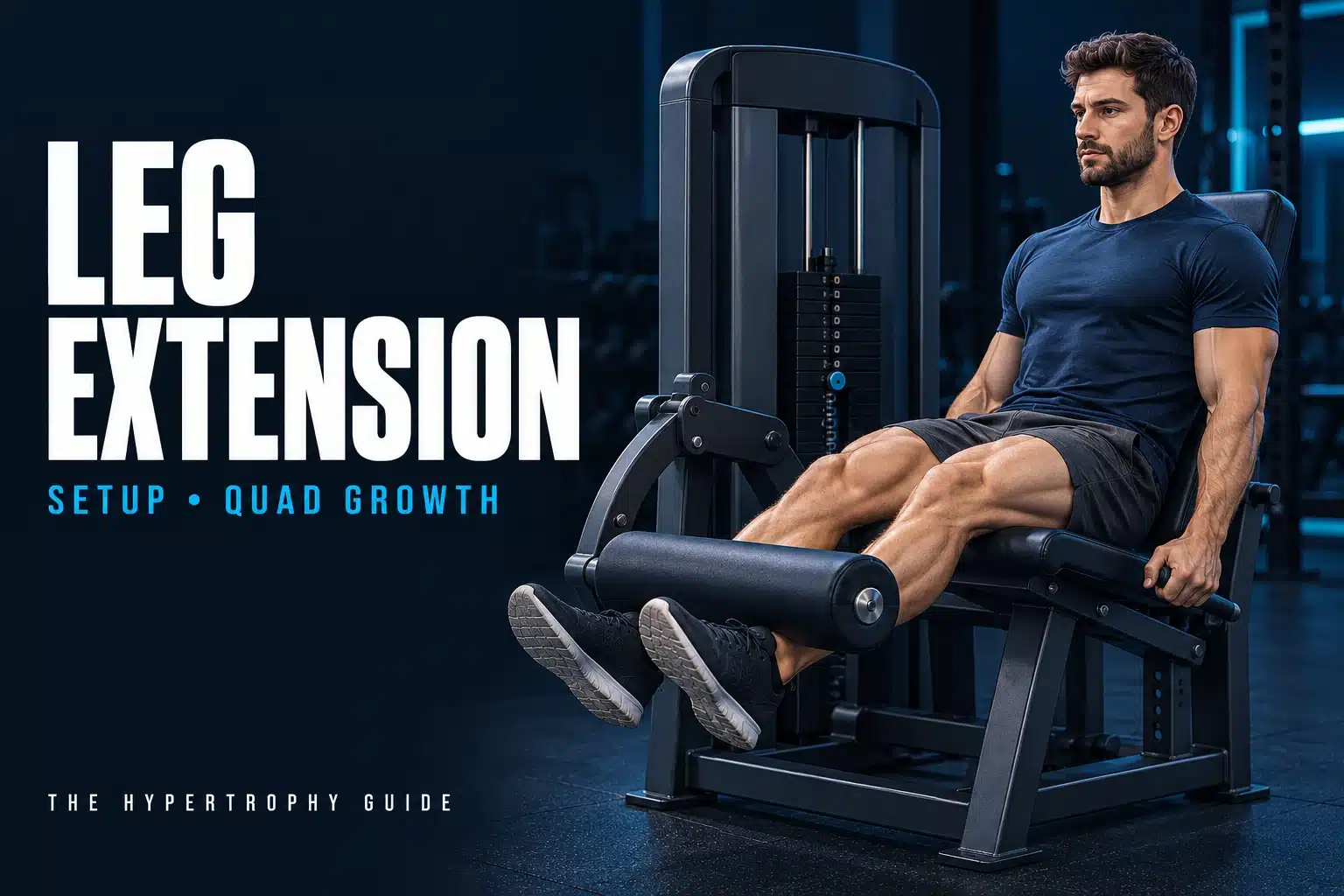
Leg extensions train your quadriceps by straightening the knee against resistance. For muscle growth, start with a machine that fits, a repeatable range of motion and working sets you can control. The weight on the stack is useful for tracking progress on that machine, not for comparing every setup in the gym.
How to Set Up a Leg Extension
Use the machine’s adjustment instructions as your starting point. Seat depth, backrest angle, starting knee angle and roller position do different jobs. Not every machine offers all four adjustments.
| Adjustment | What to check |
|---|---|
| Seat depth and back support | Sit with your hips supported and bring your knees approximately into line with the machine’s pivot. Avoid sliding forward to reach the roller. |
| Starting position | If adjustable, choose a comfortably bent-knee position you can move out of without a kick. Do not force the deepest setting simply because it is available. |
| Lower-leg roller | Position it on the lower shin, above the ankle, following the machine’s instructions. Check that it is not pressing directly on the foot or ankle joint. |
| Backrest angle | If the backrest reclines, adjust it while keeping your pelvis supported and your knee alignment sensible. Moving the seat backward is not automatically the same as reclining. |
Try a light preparation set. Extend the knees smoothly toward your comfortable straight-leg position, then control the return. Keep your hands on the handles and your hips on the seat. Increase the weight only when the settings feel workable.
Pin-Loaded vs Plate-Loaded Leg Extensions
Judge the adjustments and how the machine fits you. A selectable starting position and a movable shin pad are separate features: changing the pad height need not change the knee’s starting angle. Manufacturer descriptions of machines such as the Cybex Eagle NX explicitly distinguish those adjustments.1
When the pad presses into your shins
In my own training, pressure from the roller can become distracting as the load increases. I have sometimes used extra cushioning around the lower shin. The useful lesson is that comfort matters: I would rather concentrate on the set than rush it because the pad hurts.
Check the pad position, condition and machine fit first. Any additional padding must stay secure and must not prevent the machine from working as intended. A different machine or a lower load is a better choice than pushing through painful pressure. Knee sleeves are not required leg-extension equipment.
Should You Lean Back During Leg Extensions?
The rectus femoris crosses both the hip and knee, so changing the hip position can change its length during knee-extension work. This is different from simply selecting a deeper starting knee bend.
A ten-week study in 22 untrained men compared leg extensions with 40° versus 90° of hip flexion. The more open hip position produced greater rectus-femoris growth at the measured sites, while the vastus lateralis did not show the same advantage.2
This supports considering a reclined setup when your machine allows it. It does not establish that leaning back is best for every person, that every quadriceps muscle benefits equally, or that a particular seat setting reproduces the study. Keep your hips supported rather than manufacturing the position by arching your lower back.
If an adjustment changes how much weight you can move, establish a new baseline. A lower stack number alone does not prove that the exercise is more effective.
Full Reps, Partial Reps and Control
My default is a controlled, repeatable range: start from the bent-knee position you selected and extend as far as you comfortably can without throwing the load or forcing the joint. If your first rep is already much shorter than intended, reduce the weight or reassess the setup.
Watch for the roller losing contact with the shins, the weight crashing back down or the hips lifting off the seat. Those signs tell you to change how the set is performed; they do not reliably tell you whether the load is too light or too heavy.
Where do partial reps fit?
A partial rep covers less of the movement. It can still include both a lifting phase and a lowering phase. The concentric phase is the knee-straightening action; the eccentric phase is the controlled return. Neither term means a particular half of the range.
Near the end of a hard set, I sometimes accept shorter controlled repetitions. If you use this approach, log your complete repetitions separately and keep the extended work deliberate. A set that becomes progressively shorter from the first rep makes progression harder to judge.
Partials near the more bent-knee position are different from partials near straight knees. Do not assume that any shortened rep is “lengthened training,” or that continuing after full-range failure necessarily improves your results. Our range-of-motion guide covers the broader evidence.
Sets, Reps and How Close to Failure
I generally put leg extensions late in a full-body or leg session, after the main compound work. Most of my work has been around 10–15 reps. I have also used heavier sets around 8–10 and lighter sets around 15–20, but I prefer not to go so heavy that controlling the return becomes difficult.
My preference on familiar working sets is roughly 0–2 reps in reserve (RIR). That is a preference for this exercise, not evidence that anything easier is useless. Preparation sets and learning a different machine deserve more reserve.
| Variable | Starting choice |
|---|---|
| Working sets | 2, accounting for your other quad exercises |
| Repetitions | 10–15 with a consistent setup and range |
| Effort | About 1–2 RIR once familiar; an optional final set closer to your technical limit |
| Rest | About 2 minutes as a practical starting point; extend it if you cannot repeat useful work |
| Progression | Add reps within the range, then use the smallest practical weight increase when both sets meet the top target at the intended effort |
A study of beginners found that progressing repetitions or load both increased strength and muscle size; it does not mean you need to add weight every session.3
Does every set need to reach failure?
No. An eight-week trial in trained participants reported similar quadriceps hypertrophy with training to failure and training with repetitions in reserve.4 You can work hard without making inability to walk afterward the target. Judge the set by your control, effort and longer-term progression.
For an experienced lifter, taking a final set to the point where another repetition with the intended technique is not possible can be an option. Stop earlier while learning the setup, and do not use momentum or painful movements to keep a set going.
Drop sets and myo-reps
I have used drop sets with clients as an occasional way to make the finishing work more demanding. Pin-loaded machines make the load change convenient. It does not follow that every session needs an extended set.
A trial comparing traditional sets, drop sets and rest-pause training reported similar hypertrophy outcomes.5 Myo-reps and myo-rep matching are specific approaches, not interchangeable labels for every rest-pause protocol. This evidence does not establish that either is superior for leg extensions. Build a repeatable straight-set routine first; if you experiment, account for the extra work instead of automatically adding it to every set.
How Leg Extensions Fit With Squats and Leg Presses
Leg extensions give you direct knee-extension work alongside multi-joint leg exercises. Different movements can produce different patterns of muscle development; a direct knee-extension versus leg-press study found a greater rectus-femoris response with knee extension, while leg press also developed other lower-body muscles.6
That makes the question “What does my program need?” more useful than declaring one exercise the winner. Adding leg extensions is not automatically necessary when your existing workload already fits your goals and recovery.
Our four-day upper/lower program includes leg extensions on both lower-body days. Use it for a complete program example, or see the leg-training guide to choose your overall exercise mix.
Frequently Asked Questions
Is a pin-loaded leg extension better?
It is my usual preference for convenient weight changes and the adjustments on machines I have used. Choose by fit, available settings and control, rather than the loading system alone.
Should I move the seat all the way back?
Not automatically. Seat depth helps position your knees relative to the pivot; backrest recline changes your hip angle. Adjust each available setting to fit you instead of assuming the furthest-back notch is best.
Should my toes point up?
It can be a useful cue if it helps you move smoothly. Keep the ankle comfortable. It is not a proven requirement for greater quad growth or selective rectus-femoris recruitment.
Can I use 15–20 reps?
That is one of the ranges I have used. Choose a load you can control and track effort as well as reps. Higher reps do not turn a set into an easy set when it is taken close to your technical limit.
What if the roller hurts my shins?
Recheck the setup and padding, and reduce the load or use another machine if needed. Persistent or sharp pain deserves individual assessment rather than another generic technique cue.
Find more exercise guides in the THG exercise library.
Research and Equipment Sources
- Life Fitness/Cybex. Eagle NX Leg Extension: manufacturer description of the starting-position and lower-leg-pad adjustments. Equipment details. Manufacturer information is used for machine features, not muscle-growth claims.
- Larsen S, et al. The effects of hip flexion angle on quadriceps femoris muscle hypertrophy in the leg extension exercise. Journal of Sports Sciences. 2025. Study.
- Chaves TS, et al. Effects of Resistance Training Overload Progression Protocols on Strength and Muscle Mass. International Journal of Sports Medicine. 2024. Study.
- Refalo MC, et al. Similar muscle hypertrophy following eight weeks of resistance training to momentary muscular failure or with repetitions-in-reserve in resistance-trained individuals. Journal of Sports Sciences. 2024. Study.
- Rest-pause and drop-set training elicit similar strength and hypertrophy adaptations compared with traditional sets in resistance-trained males. Applied Physiology, Nutrition, and Metabolism. 2021. Study.
- Hypertrophic Effects of Single- versus Multi-Joint Exercise: A Direct Comparison Between Knee Extension and Leg Press. Medicine & Science in Sports & Exercise. 2026. Study.