Incline Dumbbell Press for Upper-Chest Growth: Angle, Form & Programming
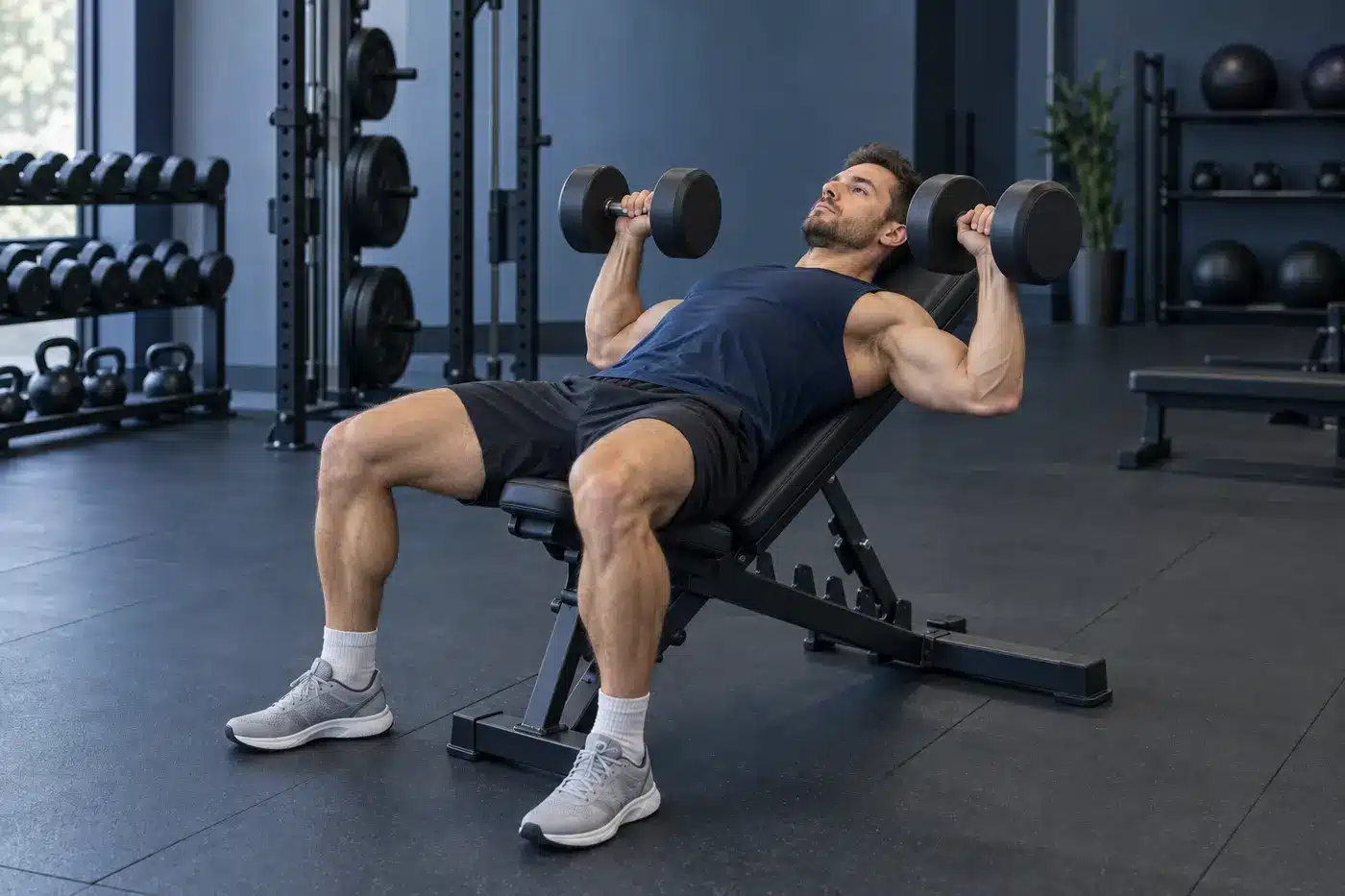
The incline dumbbell press is a useful upper-body pressing exercise that can place more emphasis on the clavicular region of the pectoralis major than a flat press. A bench angle around 15–30 degrees is a practical starting point, but no single angle is optimal for every lifter.
What Is the Best Incline Angle for Upper-Chest Growth?
There is no proven universal “best” angle. A low incline of approximately 15–30 degrees is a sensible default because it changes the line of pressing without turning the exercise into a steep shoulder press. As the bench becomes steeper, the anterior deltoid generally contributes more and many lifters feel less chest involvement.
| Bench angle | Practical effect | Best use |
|---|---|---|
| 0° / flat | Strong overall chest press; less deliberate upper-chest bias | General pressing strength and chest volume |
| 15–30° | Moderate incline with a chest-dominant feel for many lifters | Practical upper-chest default |
| 30–45° | Can increase clavicular emphasis, but often adds more anterior-delt demand | Useful when comfortable and chest tension remains clear |
| Above 45° | Progressively resembles a shoulder press | Usually better classified as shoulder-focused pressing |
An eight-week study in untrained men found that incline pressing produced a greater increase at one measured upper-chest site, while other pectoral sites and general strength outcomes were similar. The exercise was performed on a Smith machine at 44 degrees, so the result supports the idea of regional emphasis but does not prove that a 44-degree dumbbell press is uniquely superior.1
Acute studies also suggest that inclination changes regional muscle excitation, but muscle activity during one session cannot by itself predict long-term hypertrophy. The most useful angle is one that feels stable, allows a meaningful range of motion and can be progressed without persistent shoulder discomfort.2
Muscles Worked
“Upper chest” is not a separate muscle, but the clavicular portion of the pectoralis major has a different fibre direction and can be emphasised by pressing at an incline. Emphasis is not isolation: the rest of the chest, shoulders and triceps still work.
How to Perform the Incline Dumbbell Press
- Choose a manageable incline. Begin around 15–30 degrees and adjust only if another setting feels more stable and chest-focused.
- Set the dumbbells safely. Sit with the dumbbells on your thighs, then use your legs to guide them into position as you lie back.
- Create a stable base. Keep both feet planted, your upper back in contact with the bench and a natural—not exaggerated—arch.
- Use a comfortable elbow path. Let the elbows travel slightly below and outside the torso rather than flaring them to 90 degrees or pinning them against your ribs.
- Lower under control. Bring the dumbbells toward the upper-chest line until you reach the deepest comfortable position without the shoulders rolling forward.
- Press up and slightly inward. Finish with the dumbbells above the shoulders or upper chest. They do not need to collide at the top.
How deep should the dumbbells go?
Use the deepest range you can control while maintaining a stable shoulder position. Some lifters can lower the dumbbells slightly below chest level; others need to stop earlier. Dumbbells allow more freedom than a barbell, but extra depth is only useful if it remains comfortable and repeatable. Evidence across resistance training generally favours meaningful ranges of motion, although exercise-specific anatomy and tolerance still matter.3
Should the dumbbells touch at the top?
No. Bringing them closer can be a useful cue, but clanging the weights together does not add a special chest contraction. Keep the forearms and wrists stacked, finish the press smoothly and maintain control.
Incline Dumbbell Press vs Incline Barbell Press
| Factor | Dumbbells | Barbell |
|---|---|---|
| Freedom of movement | Each arm can find its own path | Hands are fixed to one bar |
| Loading | May be limited by getting heavy dumbbells into position | Usually easier to load in small, stable increments |
| Range of motion | Can allow a deeper bottom position | Bar contacts the torso and defines the bottom |
| Stability | Requires more independent control | Often easier to stabilise |
Neither implement is inherently superior for hypertrophy. Choose based on comfort, progression, equipment and the rest of the programme. Alternating them across training blocks is also reasonable.
Sets, Reps and Progression
| Use | Sets × reps | Effort | Rest |
|---|---|---|---|
| Main chest press | 3–4 × 6–10 | 1–3 RIR | 2–4 min |
| Secondary press | 2–4 × 8–15 | 1–3 RIR | 2–3 min |
| Technique introduction | 2–3 × 8–12 | 3–4 RIR | 2–3 min |
A broad range of loads can build muscle when sets are performed with sufficient effort. Heavier sets are not automatically better, and very light sets can become limited by discomfort or cardiovascular fatigue. Use a range that lets the chest remain the intended limiter and see the broader evidence on reps in reserve and weekly training volume.4
For double progression, select a range such as 8–12 reps. When all work sets reach 12 reps with the target RIR and unchanged technique, move to the next dumbbell increment. If the jump is large, allow repetitions to fall toward the bottom of the range.
Where should it go in a workout?
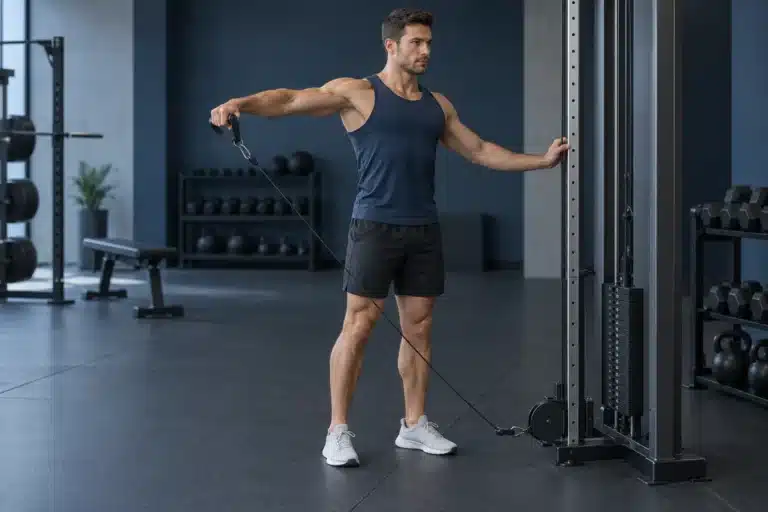
Place it early when upper-chest pressing is a priority. If a flat press or overhead press matters more, use the incline dumbbell press second. A shoulder-isolation movement such as the cable lateral raise can follow later, but it serves a different role and should not replace pressing.
Common Mistakes
Frequently Asked Questions
Is 30 degrees or 45 degrees better?
Neither is universally better. Thirty degrees is a useful chest-focused default; 45 degrees may increase clavicular and anterior-delt contribution. Use the angle you can press through a stable, comfortable range.
Does incline dumbbell press build the upper chest?
It can contribute to clavicular-pectoral growth, especially when it is progressively trained. It still trains the wider chest and is not an upper-chest isolation exercise.
Why do I only feel it in my shoulders?
The bench may be too steep, the load may be too heavy or your shoulder position may be unstable. Lower the incline, reduce the load and test a slightly different elbow path.
Are dumbbells better than a barbell for chest growth?
No clear rule makes dumbbells universally better. Dumbbells offer movement freedom and range; barbells offer stability and easier loading. Both can work.
How often should I incline press?
One or two weekly exposures are enough for most programmes, depending on total chest and shoulder volume.
Bottom Line
The incline dumbbell press is a practical option for emphasising the upper chest without requiring a special angle or technique trick. Start around 15–30 degrees, use a controlled and comfortable range, keep the setup repeatable and progress within a moderate rep range.
References
- Chaves SFN, et al. Effects of horizontal and incline bench press on neuromuscular adaptations in untrained young men. Int J Exerc Sci. 2020.
- Albarello JC, et al. Non-uniform excitation of pectoralis major induced by changes in bench press inclination. J Strength Cond Res. 2022.
- Pallarés JG, et al. Effects of range of motion on resistance training adaptations: a systematic review and meta-analysis. Scand J Med Sci Sports. 2020.
- Schoenfeld BJ, et al. Strength and hypertrophy adaptations between low- vs high-load resistance training: a systematic review and meta-analysis. J Strength Cond Res. 2021.