Mechanical Tension vs Metabolic Stress: What Builds Muscle?
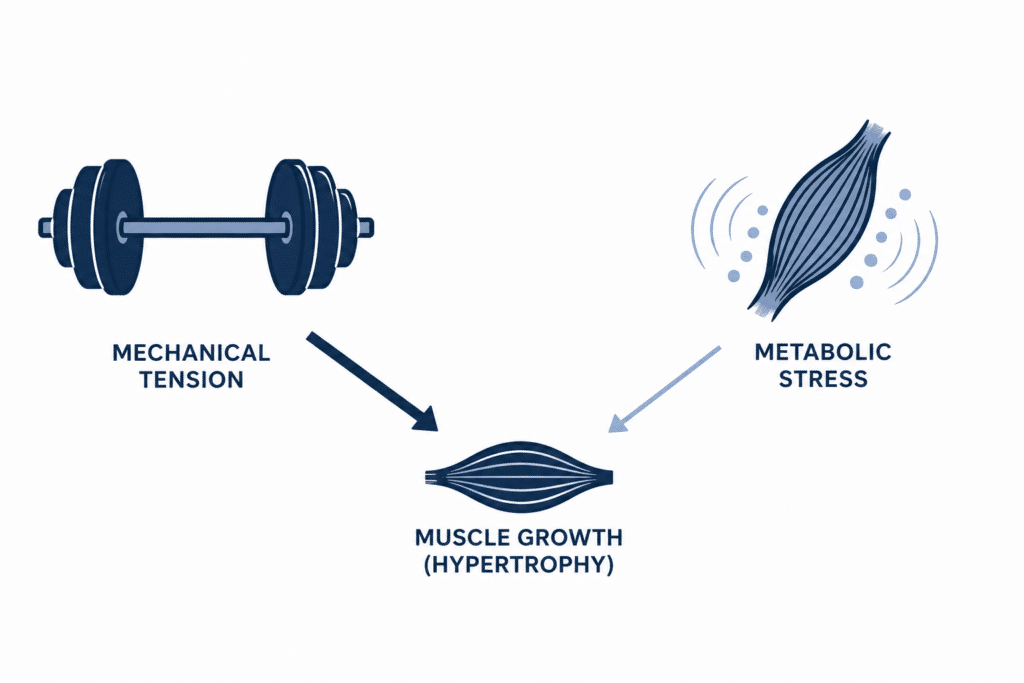
Mechanical tension is the central stimulus for muscle hypertrophy. Metabolic stress—the burn, metabolite accumulation, and pump produced during hard sets—may accompany or support productive training, but it is not a reliable target on its own. You do not need to choose between tension and a pump. You need exercises and sets that load the target muscle effectively, progress over time, and create a recoverable training stimulus.
Mechanical Tension vs Metabolic Stress: Quick Comparison
| Mechanical tension | Metabolic stress | |
|---|---|---|
| What it describes | Force experienced by active muscle fibers under load | Local metabolic changes created by repeated contractions |
| Commonly associated with | Challenging loads, high motor-unit recruitment, lengthened loading, progression | Burning, pump, high repetitions, short rests, restricted blood flow |
| Role in hypertrophy | Central initiating stimulus through mechanotransduction | Possible secondary or amplifying role; difficult to isolate independently |
| Useful training signal? | Yes, when the target muscle is actually producing force | Sometimes, but a pump does not prove an effective stimulus |
| Should you maximize it? | Create sufficient tension with productive, recoverable sets | No need to maximize burn or pump at the expense of performance |
What Is Mechanical Tension?
Mechanical tension refers to the force experienced by muscle fibers as they actively produce force against resistance. Muscle cells can detect mechanical loading and convert it into molecular signals—a process called mechanotransduction—that contributes to the adaptations underlying hypertrophy.
In practical training, useful tension depends on more than the number printed on the weight:
- The target muscle must contribute meaningfully to the movement.
- The set must be challenging enough to recruit and fatigue relevant muscle fibers.
- The exercise should provide a stable, repeatable way to apply force.
- The load and technique should allow useful tension through an appropriate range of motion.
- The stimulus must be repeated and progressed across weeks and months.
This is why “lifting heavier” is not a complete definition of tension. Adding weight can increase the external demand, but it does not help if technique changes move the work away from the target muscle or reduce the useful range of motion.
What Is Metabolic Stress?
Metabolic stress describes the local metabolic environment created during repeated muscular contractions. It is associated with metabolite accumulation, reduced oxygen availability, cell swelling, the burning sensation, and the temporary increase in muscle size commonly called a pump.
It tends to increase with:
- Higher-repetition sets
- Short rest intervals
- Continuous-tension techniques
- Drop sets and similar fatigue methods
- Blood-flow-restriction training
These methods can build muscle. However, that does not prove that metabolic stress independently caused the growth. They also involve repeated force production and recruitment of muscle fibers. In human training research, tension, fatigue, recruitment, metabolites, and effort often change together, making a clean separation difficult.
Is Mechanical Tension the Main Driver of Muscle Growth?
The current evidence supports load-induced mechanical tension as the central stimulus initiating resistance-training hypertrophy. That does not mean every fiber needs an extremely heavy weight or that metabolic factors have no role. It means muscle growth ultimately requires active muscle fibers to experience sufficient mechanical loading.
This interpretation also explains why muscle can grow across a broad range of loads. Meta-analyses generally find similar hypertrophy with lower and higher loads when sets are sufficiently challenging, although heavier loads are usually better for maximal strength. With lighter loads, fatigue progressively increases recruitment and makes the remaining repetitions mechanically demanding for active fibers.
Very light loads can become inefficient or suboptimal because cardiovascular discomfort and long set duration may limit performance before the target muscle receives the intended stimulus. Load still matters; it simply is not the only variable.
Does the Pump Cause Muscle Growth?
A pump does not prove that a set will build muscle. It is a temporary response to blood flow and fluid shifts, not a direct measurement of long-term hypertrophy.
A pump can still be useful feedback. If a stable curl produces a strong biceps pump while the biceps are trained close to their limit, the pump is compatible with a productive set. But you can also create an enormous pump with partial, low-effort repetitions that never provide a progressive stimulus.
Think of the pump as a possible side effect—not the scorecard. Better long-term indicators include:
- Stable technique and target-muscle execution
- Progress in repetitions, load, or controlled performance
- Productive sets performed with an appropriate effort
- Recovery that allows you to repeat and progress the training
- Changes in measurements, photos, and performance across months
Do You Need to Train to Failure?
No. Training to momentary failure is not required for hypertrophy, and meta-analyses do not show it to be consistently superior to stopping short of failure. However, a set generally needs to be challenging enough to provide meaningful recruitment and tension—especially when loads are light.
For many exercises, finishing most working sets within roughly 0–3 reps in reserve is a practical approach. The appropriate target depends on the exercise, fatigue cost, safety, experience, and how accurately you estimate RIR.
Heavy vs Light Weights: Where Does Tension Come From?
| Load range | How tension develops | Main trade-off |
|---|---|---|
| Heavy | High force demand and recruitment occur early | More joint, technical, and systemic demand; fewer repetitions |
| Moderate | High tension and recruitment develop across a manageable set | Often a practical balance for hypertrophy |
| Light | Fatigue increases recruitment as the set approaches its endpoint | More burn, longer sets, and greater discomfort |
The best hypertrophy program does not need one universal repetition range. Choose loads that let you train the target muscle hard, maintain execution, progress reliably, and manage fatigue. The guide to training intensity for hypertrophy explains the difference between load and effort in more detail.
When Metabolic Stress Can Be Useful
Metabolic-stress-heavy methods are tools, not foundations. They can be useful when:
- You want a time-efficient final set, such as a drop set.
- Heavy loading is temporarily uncomfortable or impractical.
- You use isolation exercises where local fatigue is easy to manage.
- You deliberately use low-load blood-flow-restriction training.
- You want training variety without replacing progressive work.
The problem begins when short rests and advanced methods reduce performance so much that later sets become lower quality, or when soreness and fatigue replace progression as the objective. Longer rest intervals often preserve repetitions and load, which may slightly benefit hypertrophy compared with rests under one minute.
How I Use This in My Own Training
I enjoy a pump, but I do not use it to decide whether a workout worked. In my own upper/lower training, I care more about whether the exercise remains stable, whether the target muscle is limiting the set, and whether I can improve a controlled repetition or load over time.
This is also why I often use only a few hard sets per exercise. Adding more burning sets can make a session feel productive without necessarily improving the stimulus-to-fatigue ratio. I would rather keep the sets I can execute and recover from than chase a sensation that disappears shortly after training.
Practical Checklist for Productive Tension
- Choose the target: Which muscle should be limiting the exercise?
- Create stability: Can you produce force without balance or another body part ending the set?
- Use a workable load: Can you maintain useful technique through a challenging set?
- Train hard enough: Is the set sufficiently close to your current repetition limit?
- Track progression: Are repetitions, load, control, or range improving?
- Manage volume: Can you recover and perform again? See the guide to optimal training volume.
For a broader framework, use the guide to choosing exercises for muscle growth.
The Bottom Line
Mechanical tension is the central stimulus for hypertrophy. Metabolic stress may accompany or contribute to productive resistance training, but maximizing the pump, burn, or fatigue is not required. Build your program around challenging target-muscle tension, good execution, progression, sufficient volume, and recovery. Treat the pump as optional feedback—not proof of growth.
FAQ
Is mechanical tension more important than metabolic stress for hypertrophy?
Mechanical tension is considered the central initiating stimulus for resistance-training hypertrophy. Metabolic stress may accompany or support productive training, but its independent contribution is harder to isolate and maximizing it is not required.
Does a muscle pump mean the workout caused growth?
No. A pump can occur during an effective set, but it is a temporary response and does not prove long-term muscle growth. Progression, execution, productive effort, and recovery are better indicators.
Can light weights create enough mechanical tension?
Yes. Lighter loads can build muscle when sets are sufficiently challenging. Fatigue increases recruitment as the set progresses, although very light loads may become uncomfortable and inefficient.
Do short rest periods build more muscle through metabolic stress?
Not necessarily. Short rests increase metabolic stress but can reduce repetitions and load in later sets. Rest long enough to preserve productive performance; research suggests intervals longer than 60 seconds may offer a small hypertrophy advantage.
Is metabolic stress useless for hypertrophy?
No. Metabolic stress may contribute and methods that create it can still build muscle. The practical point is that you do not need to maximize burn or pump, and these sensations should not replace tension, progression, and recoverable training.
References
- Lim C, Nunes EA, Currier BS, et al. An evidence-based narrative review of mechanisms of resistance exercise-induced human skeletal muscle hypertrophy. Medicine & Science in Sports & Exercise. 2022;54:1546–1559. PubMed.
- Wackerhage H, Schoenfeld BJ, Hamilton DL, Lehti M, Hulmi JJ. Stimuli and sensors that initiate skeletal muscle hypertrophy following resistance exercise. Journal of Applied Physiology. 2019;126:30–43. PubMed.
- Schoenfeld BJ, Grgic J, Ogborn D, Krieger JW. Strength and hypertrophy adaptations between low- vs. high-load resistance training: a systematic review and meta-analysis. Journal of Strength and Conditioning Research. 2017;31:3508–3523. PubMed.
- Refalo MC, Helms ER, Trexler ET, Hamilton DL, Fyfe JJ. Influence of resistance training proximity-to-failure on skeletal muscle hypertrophy: a systematic review with meta-analysis. Sports Medicine. 2023;53:649–665. PubMed.
- Singer A, et al. Give it a rest: a systematic review with Bayesian meta-analysis on the effect of inter-set rest interval duration on muscle hypertrophy. Sports Medicine. 2024. PubMed.